Factories of Stories
Story telling at the Uffizi Galleries
- 1/24Gentile da Fabriano, Adoration of the Magi
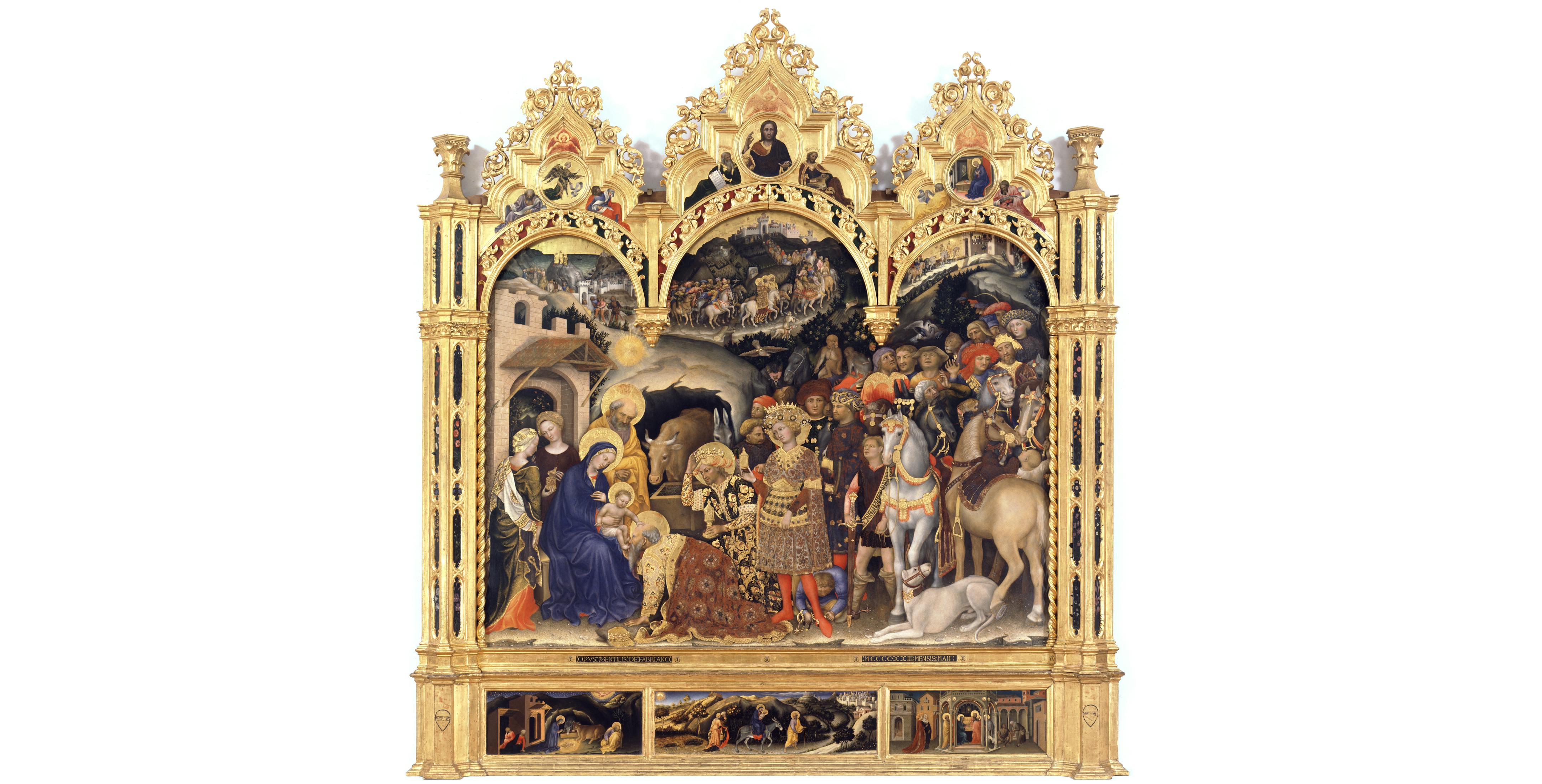
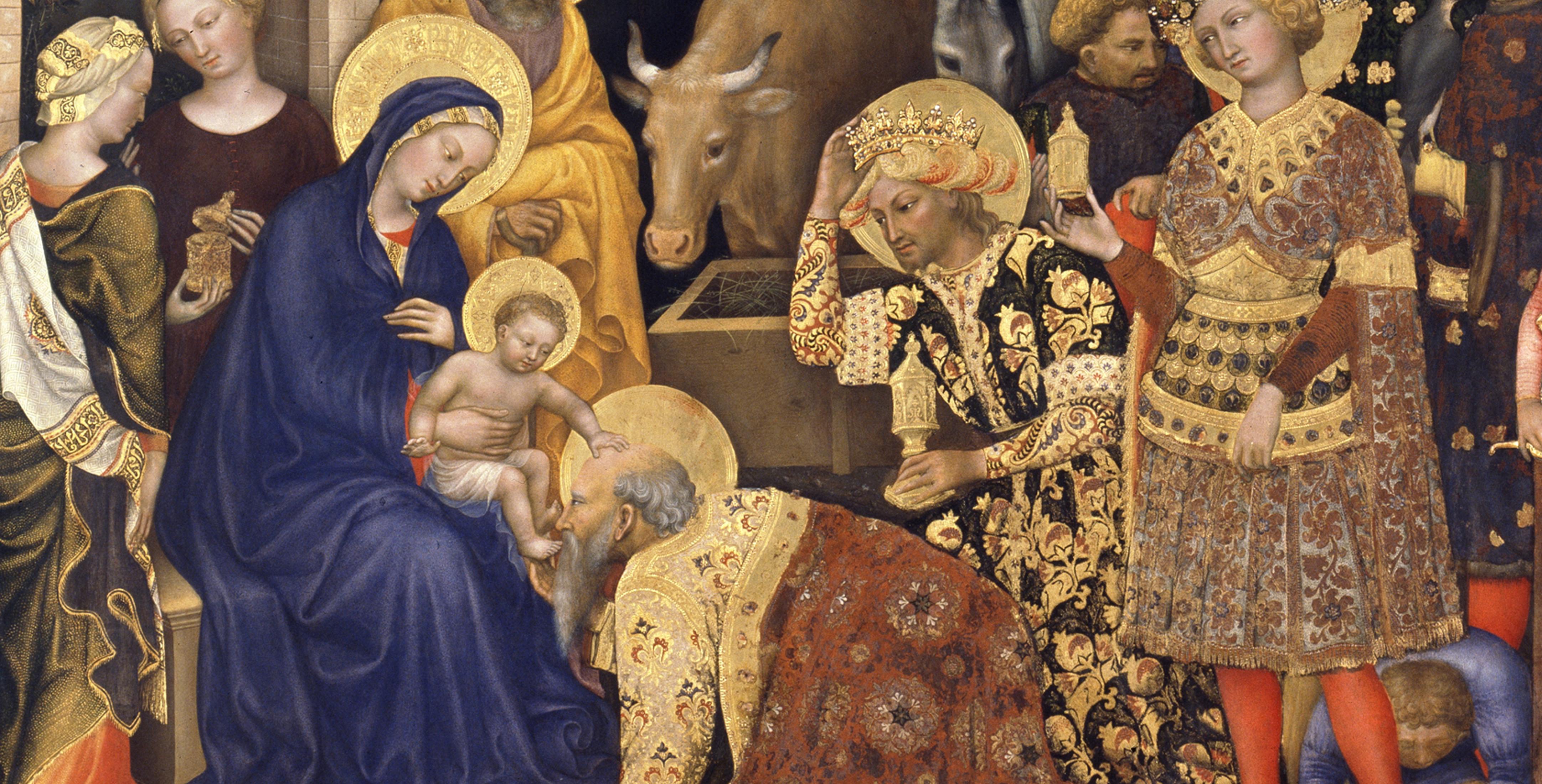
On a journey, following a star. To meet the Child, here in the foreground.
But this is just the end of a story that starts in the Far East: a journey of nine months, as the apocryphal Gospels tell us.
In the three lunettes of the frame, we can follow the procession of the Magi.
In the top left, the three wise men, dressed in gold, are gazing at the star from a mountain peak overlooking the sea.
I wonder: is it possible that, in spite of their precious robes, they too felt the bewilderment and uncertainty of the journey? That, in spite of the lavish procession, they felt alone? That, once at their destination, they longed to return home?
The sea breeze accompanied my journey. I left Alexandria to arrive in a small town on the Ligurian coast. I was 25.
When I arrived in Italy, everything was new: the language, the culture, the traditions. The homesickness I felt for my birthplace was replaced by the nostalgia for the person I was when I lived there, with my life, with my loved ones.
And there they are, in the central lunette, the Magi crossing the idyllic landscape to enter Jerusalem. The cultivated land and the blossoming trees are painted in great detail. I can smell the scent of my land, the embrace of the warm air.
The journey of the three wise men has become an exotic hunting trip, with cheetahs sitting on horseback. After meeting Herod in his palace, the Magi ask him:
“Where is He who has been born king of the Jews? For we saw His star in the east, and have come to worship Him”.
Then Herod summoned the Wise Men secretly and learned from them the precise time the star had appeared and sending them to Bethlehem, he said, “Go and make careful search for the child; and when you have found Him, report to me, that I too may come and worship Him.”
In the top right, finally, the Magi enter Bethlehem, then continue down to where the Child, Mary and her husband are.
The star, almost close enough to touch, now shines above Joseph’s head.
The three wise men from the East are represented as the three ages of man. During different stages of their lives, they have all been able to face their challenges.
According to tradition, the Magi were wise astronomers. For them, travel was a source of knowledge and renewal, which is how it was for me. Understanding Italian society, language and culture became an urgent need.
Through words I have become more complete as a person, freer: this is what mastering a new language meant to me.
When I became an Italian citizen, I started to travel through Europe with my children. These journeys were so different from the one that brought me to Italy many years ago. Today I am no longer afraid. For me, every journey means acquiring new treasures, meeting new people.
Gentile da Fabriano, the artist who painted this precious panel, travelled a lot too. Unlike other painters from his time, who preferred to set up a workshop, he was a travelling painter from a young age. He moved about continuously between the Marche, Lombardy and Venice. Then, finally, he reached Florence. Here he found a new way to make art, which he embraced with an open, curious mind, although he remained faithful to his late-Gothic artistic roots. Thus, for example, he enjoyed playing with illusions of depth, created by the horses in the foreground, but at the same time, he maintained as main points of view as there are episodes narrated in the painting, in order to show off his exuberant decorative and descriptive tastes.
Opening up to new things while remaining true to ourselves and preserving a living link with our roots is what I have done with my three children. As they have grown up, they have enjoyed the freedom of this country, but also the solid nature of their roots.
This ability to open up to the new, while maintaining a sense of their origins has been the result of my being with them. A large undertaking, made up of small things.
In the morning, in our house, we wake at dawn, and each one of us pray in silence.
In the Koran, there is a verse that says: “WA KOL RABI ZEDNI ELMA”, “My Lord, increase me in knowledge”.
In the early days in Italy, prayer was not enough to placate my worries or to make me feel less lonely. Knowledge led me to pray in a way that was more mature, more aware.
And it is talking about prayer that I realize how there is a great unity in this painting, given by the prevalence of gold. The inclusion of raised parts adds three-dimensionality to the scene, in the same way that the use of gold leaf is important to add a realistic depiction of the rich fabrics: Gentile da Fabriano pays particular attention to the taste and fashion of the period, probably at the request of Palla Strozzi, the rich Florentine banker, but also educated man of letters, who commissioned this panel and is depicted here, behind the youngest of the Magi.
On a symbolic level, however, gold refers to divine light and defines a holy space. The presence of God brings harmony even where there is diversity.
True wealth does not lie in the material value of gold, but in faith, in knowledge and in the journey.
“And having been warned in a dream not to return to Herod, they departed for their own country by another way".
The Magi went home “by another way” because their lives had changed.
My life also changed, and today I am surprised to see, in the center of the bottom predella, these small figures fleeing to safety, towards my land, Egypt.
Text by Zeinab Kabil
Voice by Laura Curino
Artwork detailsAdoration of the MagiPainting | The Uffizi - 2/24Gentile da Fabriano, Adoration of the Magi
The three wise men from the East are represented as the three ages of man. During different stages of their lives, they have all been able to face their challenges.
According to tradition, the Magi were wise astronomers. For them, travel was a source of knowledge and renewal, which is how it was for me. Understanding Italian society, language and culture became an urgent need.
Through words I have become more complete as a person, freer: this is what mastering a new language meant to me.
When I became an Italian citizen, I started to travel through Europe with my children. These journeys were so different from the one that brought me to Italy many years ago. Today I am no longer afraid. For me, every journey means acquiring new treasures, meeting new people.
Gentile da Fabriano, the artist who painted this precious panel, travelled a lot too. Unlike other painters from his time, who preferred to set up a workshop, he was a travelling painter from a young age. He moved about continuously between the Marche, Lombardy and Venice. Then, finally, he reached Florence. Here he found a new way to make art, which he embraced with an open, curious mind, although he remained faithful to his late-Gothic artistic roots. Thus, for example, he enjoyed playing with illusions of depth, created by the horses in the foreground, but at the same time, he maintained as main points of view as there are episodes narrated in the painting, in order to show off his exuberant decorative and descriptive tastes.
Opening up to new things while remaining true to ourselves and preserving a living link with our roots is what I have done with my three children. As they have grown up, they have enjoyed the freedom of this country, but also the solid nature of their roots.
This ability to open up to the new, while maintaining a sense of their origins has been the result of my being with them. A large undertaking, made up of small things.
In the morning, in our house, we wake at dawn, and each one of us pray in silence.
In the Koran, there is a verse that says: “WA KOL RABI ZEDNI ELMA”, “My Lord, increase me in knowledge”.
In the early days in Italy, prayer was not enough to placate my worries or to make me feel less lonely. Knowledge led me to pray in a way that was more mature, more aware.
And it is talking about prayer that I realize how there is a great unity in this painting, given by the prevalence of gold. The inclusion of raised parts adds three-dimensionality to the scene, in the same way that the use of gold leaf is important to add a realistic depiction of the rich fabrics: Gentile da Fabriano pays particular attention to the taste and fashion of the period, probably at the request of Palla Strozzi, the rich Florentine banker, but also educated man of letters, who commissioned this panel and is depicted here, behind the youngest of the Magi.
On a symbolic level, however, gold refers to divine light and defines a holy space. The presence of God brings harmony even where there is diversity.
True wealth does not lie in the material value of gold, but in faith, in knowledge and in the journey.
“And having been warned in a dream not to return to Herod, they departed for their own country by another way".
The Magi went home “by another way” because their lives had changed.
My life also changed, and today I am surprised to see, in the center of the bottom predella, these small figures fleeing to safety, towards my land, Egypt.
Text by Zeinab Kabil
Voice by Laura Curino
Artwork detailsAdoration of the MagiPainting | The Uffizi - 3/24Thebaid, attributed to Fra Angelico
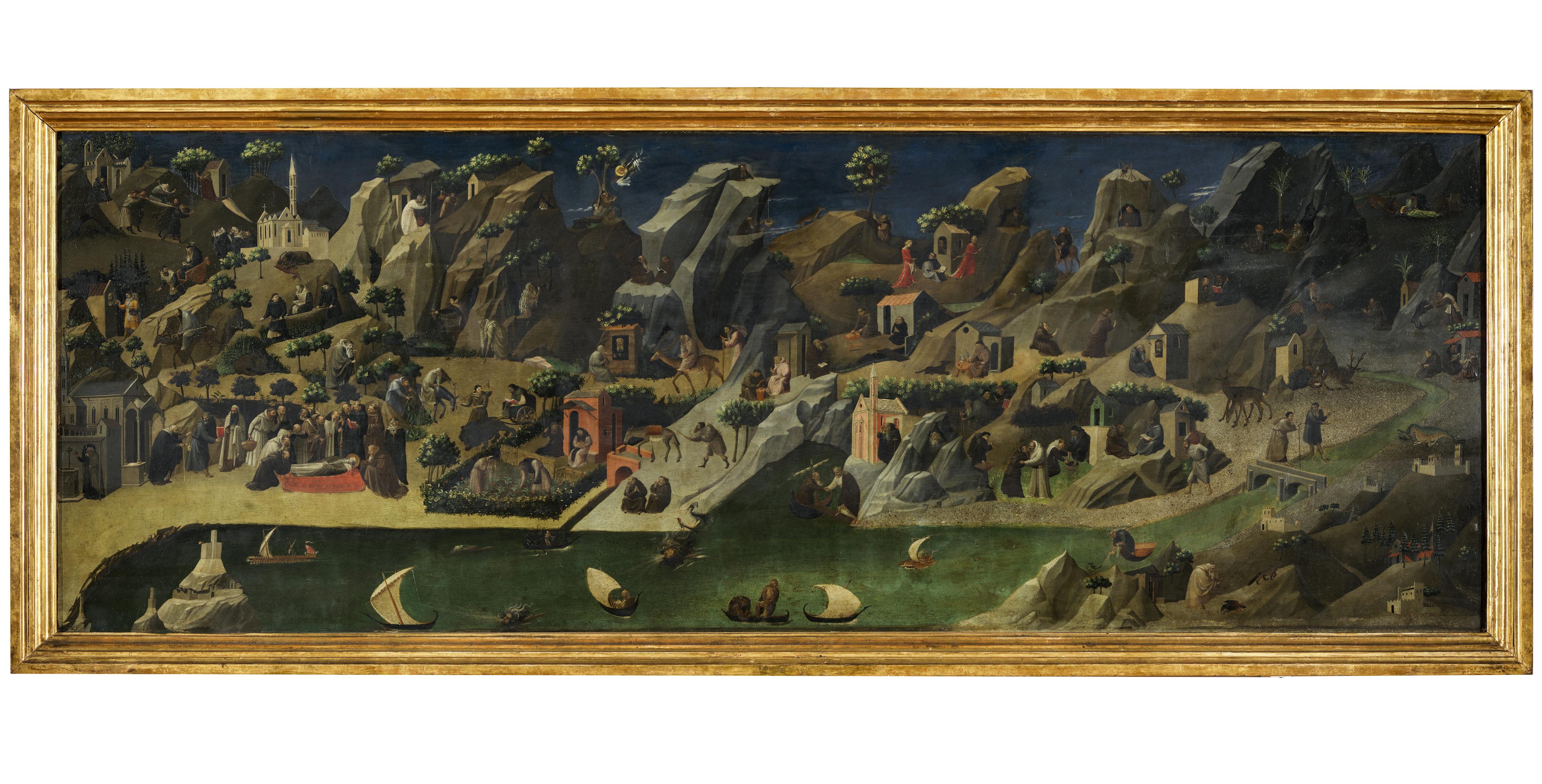
In this painting, no one is alone.
This is what captured my attention as soon as I approached the Thebaid: life buzzing in what should be the desert near Thebes, in Egypt.
I can hear the voices of the many people travelling through it or living there. I can feel the wind that blows over the river, rippling its surface, and through the trees, rustling the leaves.
It is an idealized landscape, but portrayed in minute detail.
A place where nature is a friend to man, and man is a friend of nature.
Only the distant mountains look bare and desolate.
It should be a desert, yet it is a garden; it should be a place of solitude, yet it is filled with relationships. As Athanasius, Bishop of Alexandria wrote, the desert had become “a city”.
Mashhad is the name of a holy city in the north east of Iran. Here, in 817 AD, Reza, eighth Shi'ite Imam, died and an imposing mausoleum was built in his name. Since then, what was once a small village was transformed not only into a large city, but also into the most important destination for pilgrims in my country. Every year, more than 25 million Shi’ites from Iran and elsewhere walk its streets. That is why a sanctuary has been built around the mausoleum, creating a genuine city within the city.
The heart of the sanctuary is always full of people, even late at night. Pilgrims try to touch the holy
The scenery in the Thebaid, partly inhospitable, is brought to life by the relationships that populate it; it is a place not just of isolation, but also of shared exchanges.
I think that ultimately this painting reflects the two extremes of life, and not just in religious terms. There is a space for silence and one for relationships. It is up to us to find a balance.
The disorderly scene before us is only apparently so. At first glance, the lack of a centre leaves us disorientated, but every scene has its own precise symbolic significance. The episodes shown here are taken more or less directly from literary sources; first and foremost, from a collection of hagiographic texts, known as the Lives of the Desert Fathers, which first arrived in Italy well before the 15th century and was gradually translated from Greek into Latin and then into vernacular.
The success of the Thebaid scenes, frescoed or painted on panels and representing the lives of
themen (and women) who were famous for their spirituality or virtues, was determined by the increasing spread through Italy of the Lives of the Desert Fathers, which in turn was closely connected with the birth of the so-called preaching orders: the Franciscans and Dominicans. This success, however, was particularly ephemeral: the Thebaid scenes we know today – ten in total, including the one on display at the Uffizi – were mainly painted in Florence over a period of just fifty years, starting in the early decades of the 15th century. Then they disappeared as suddenly as they had appeared.However, this was just the beginning of their story and of their journey through time: the Thebaid scenes, more often painted on panels rather than as frescoes, were uprooted from their context and, in some cases, cut and disassembled.
My friends and I were also split up. There were seven of us, we met in the first year of high school. We used to go to the mountains together. In winter, it was wonderful; we never knew how deep the snow would be, and so we would proceed in single file; whoever was in front would leave footprints for the others to follow. When we sank into the snow, our laughter would echo around the mountains. Then we would heat food on small stoves. Outside the refuge, at sunset, we would all be in a circle, laughing and eating, enjoying the natural surroundings and being together.
With the revolution and the war with Iraq, we all left or fled; all except one. For years, we lost sight of one another. Then, when each of us was settled, we were able to get back in touch.
For the past seven years, we have been meeting up every year. All except one, Ali Reza, our friend who stayed in Iran. It is great to get together, like fragments of a painting that have been reassembled.
On the banks of the river, a monk greets another who has just arrived by boat. Or is he the one getting into the boat so that they can leave together?
Water is one of the protagonists of the Thebaid. The springs, the large river and on the left, in the foreground, a strait that probably leads to the sea. Water has transformed the desert into an oasis. And it is water that has made this a habitable place.
In the sanctuary of Mashhad, nine large porticoed courtyards were built to welcome pilgrims. In many of them, there is a beautiful fountain, with taps to allow believers to purify themselves before prayer, and there is no shortage of large containers filled with cool water to quench thirst in the summer.
Everywhere you can smell the heady scent of rosewater.
Thebaid scenes realized in fresco form could be seen by many and had a narrative purpose. Those executed on panels, seen by few, were a support for meditation, since these were images that were “useful to the soul”, whose contemplation led to God. They would probably have been found in the chapter house, an emblematic place for the monastic community. It was in this space that in the evening, after dinner in the refectory, the Lives of the Desert Fathers would be read aloud by one of the brothers, and then visualized by each monk in the silence of his cell, to accompany the nighttime meditation.
I like to think that these monks lived through something similar to what I feel when I am fasting during the month of Ramadan. It is a purification that trains the brain and the heart. Like vaccination to boost the immune system. Like achieving a level of concentration that suspends hunger and thirst.
As a child, I would go to the mosque; my father would take me and we would pray with the others. I liked the fact that so many people were there; after prayer, we would talk and spend time together. Then preaching became too intolerant. I don’t like those who believe they possess the truth and don’t accept others in their diversity. For many years now, I have been praying alone.
In the Thebaid, monks have their own cell, cave or hermitage, but they live together in prayer.
The relationships between the monks are full of gestures of care. No one is in command. No one feels superior to the others.
Text by Mohammad Aletaha
Voice by Marco Paolini
- 4/24Thebaid, attributed to Fra Angelico
On the banks of the river, a monk greets another who has just arrived by boat. Or is he the one getting into the boat so that they can leave together?
Water is one of the protagonists of the Thebaid. The springs, the large river and on the left, in the foreground, a strait that probably leads to the sea. Water has transformed the desert into an oasis. And it is water that has made this a habitable place.
In the sanctuary of Mashhad, nine large porticoed courtyards were built to welcome pilgrims. In many of them, there is a beautiful fountain, with taps to allow believers to purify themselves before prayer, and there is no shortage of large containers filled with cool water to quench thirst in the summer.
Everywhere you can smell the heady scent of rosewater.
Thebaid scenes realized in fresco form could be seen by many and had a narrative purpose. Those executed on panels, seen by few, were a support for meditation, since these were images that were “useful to the soul”, whose contemplation led to God. They would probably have been found in the chapter house, an emblematic place for the monastic community. It was in this space that in the evening, after dinner in the refectory, the Lives of the Desert Fathers would be read aloud by one of the brothers, and then visualized by each monk in the silence of his cell, to accompany the nighttime meditation.
I like to think that these monks lived through something similar to what I feel when I am fasting during the month of Ramadan. It is a purification that trains the brain and the heart. Like vaccination to boost the immune system. Like achieving a level of concentration that suspends hunger and thirst.
As a child, I would go to the mosque; my father would take me and we would pray with the others. I liked the fact that so many people were there; after prayer, we would talk and spend time together. Then preaching became too intolerant. I don’t like those who believe they possess the truth and don’t accept others in their diversity. For many years now, I have been praying alone.
In the Thebaid, monks have their own cell, cave or hermitage, but they live together in prayer.
The relationships between the monks are full of gestures of care. No one is in command. No one feels superior to the others.
Text by Mohammad Aletaha
Voice by Marco Paolini
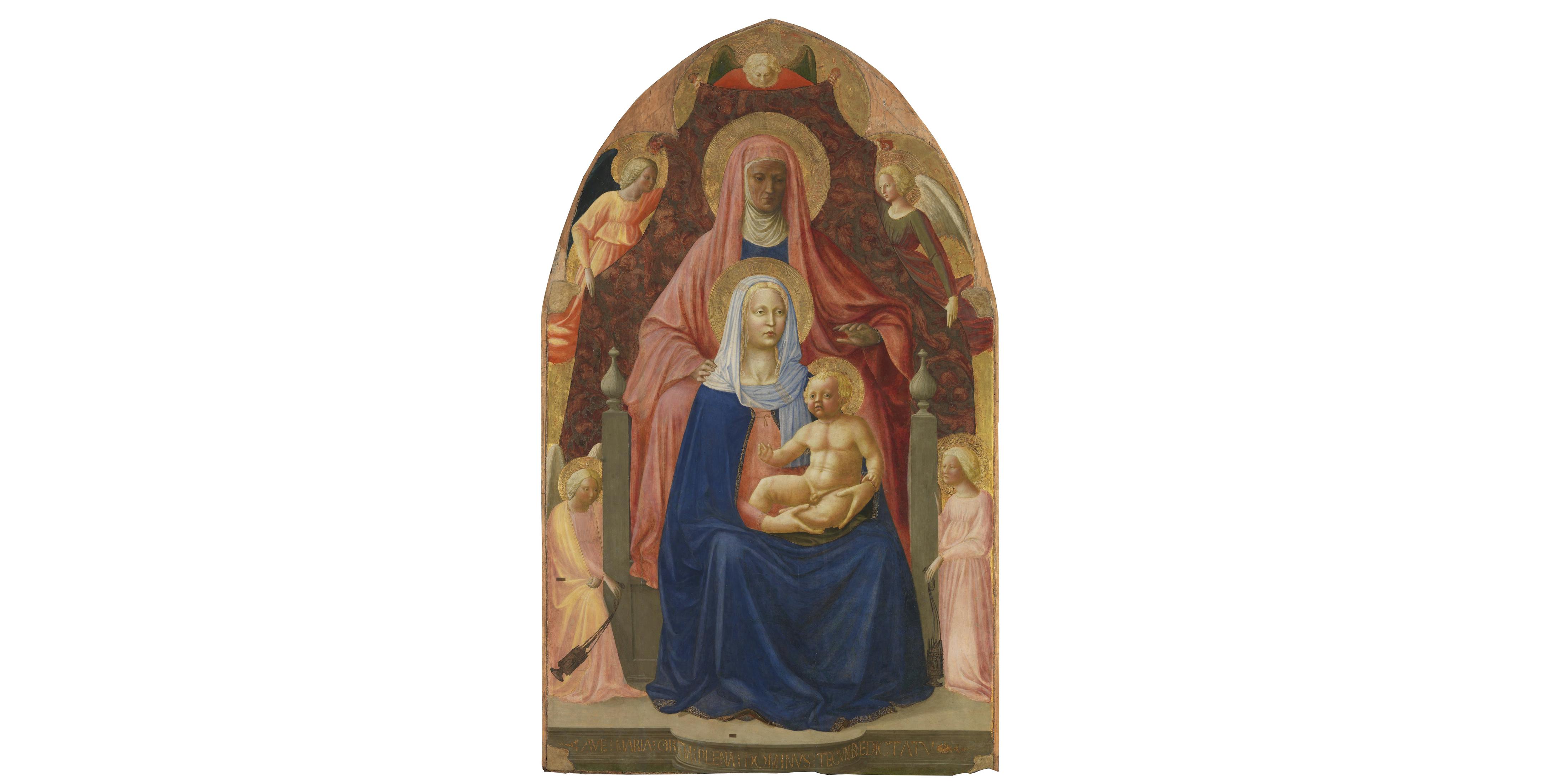
- 5/24Masaccio e Masolino, Saint Anne, Madonna and Child, five angels (called ‘Sant'Anna Metterza’)
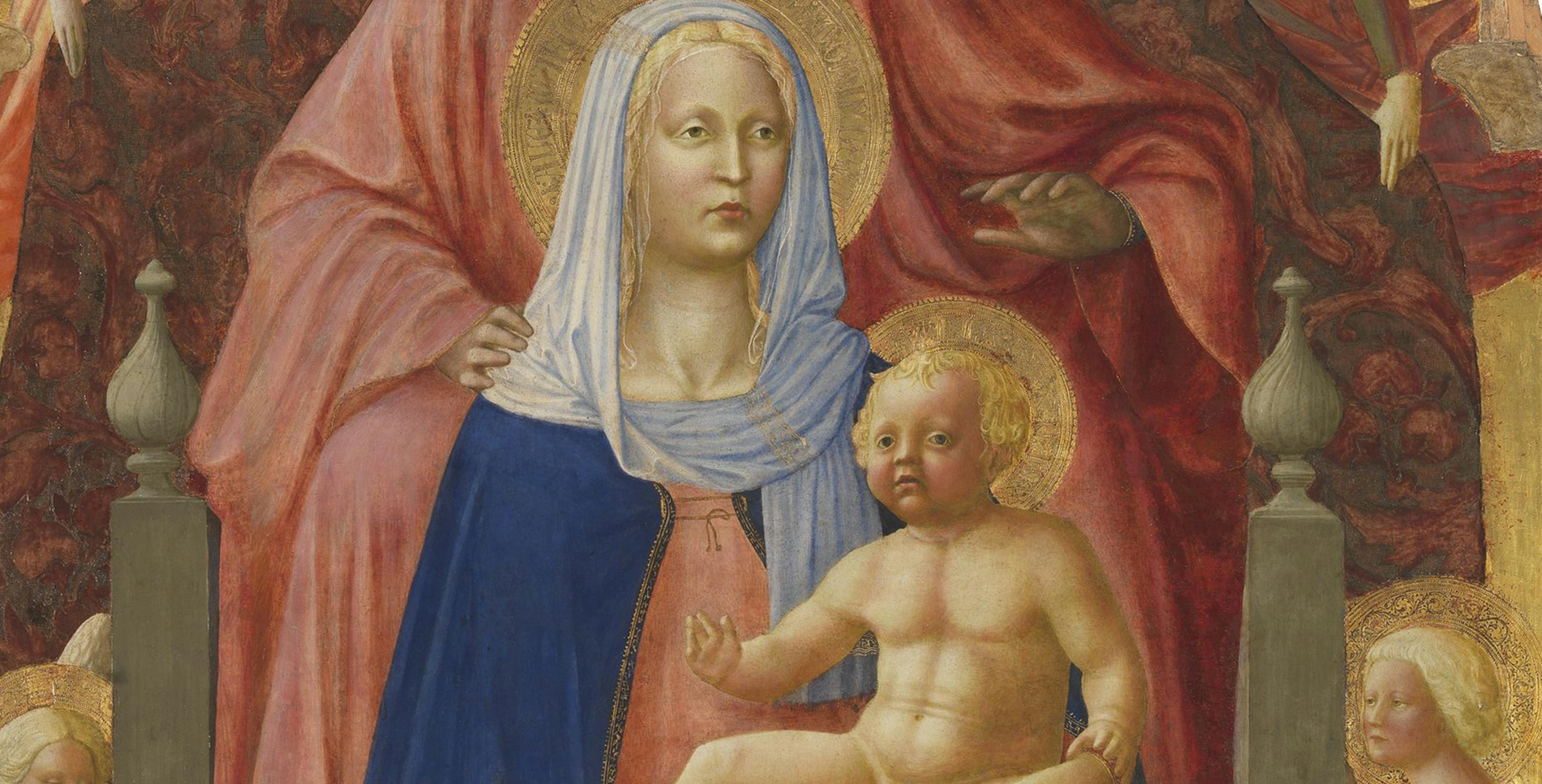
A hand on a shoulder brings comfort, even if that hand is small, slender and apparently fragile.
Here, before this heavenly vision, my gaze moves upwards towards the sky and vice versa, down towards the ground. This dual portrait of motherhood is all inside this vertical line, marking the passage from one generation to another: affection, protection, solidarity, trust, courage, from one to the other, through to the Child on his mother’s knees. This however, is not conveyed in words, but rather, in gestures and presence; it is a link that is both strong and gentle.
Now, in this room there is a mother holding her child in her lap, with another woman to protect and guide her. A look that follows affectionately, and one I know well. I am the mother of two girls but, before that, I was a daughter. Between my mother and myself, the same daily acts of care, but which were and which said much more. My mother, behind me, speaking to me as she combed my hair while I listened to her words, often repeated, often the same: advice, deep and simple thoughts about things, while my gaze was elsewhere, my mind on other things for the day, caught up in the worries of the moment.
Angels move around this apparition, carrying a golden cloth, swinging the thurible, guiding our eyes towards the group of three in the center, joined together by life.
Mary’s dress delicately outlines her body, which still seems to bear the signs of pregnancy.
In popular tradition, St Anne is the patron saint of mothers who have recently given birth. Hers is a safe presence behind Mary. In mid-air, her left hand extends into the empty space above the Child, as if to create a protective space that is easily visible to her eyes.
I am inside a grey room. It is day, but the lighting is totally artificial. I feel alone and wish there could be a hand to hold on to, to give me courage to face this moment that will change my life forever. In my head, I can still hear the words of someone suggesting that the hand I was seeking was yours, Emma.
There was so much pain, but your little hand brought us both out, into the real light.
Like the tiny hand of Jesus, resting gently on his mother’s arm, like a light caress to feel her presence and to accompany her embrace.
Depicted behind Mary, as though she were supporting the whole family, St Anne was also referred to as “metterza”, i.e., placed in the third position in relation to the figures of the Virgin and Child. This painting was commissioned by the Bonamici family, Florentine weavers, for their chapel in Sant’Ambrogio.
The panel was executed by two Florentine masters from the early 15th century: Masolino and Masaccio, two artists with different temperaments, who managed to achieve an extraordinary balance in this work.
Such close collaboration for an altarpiece is not exceptional in the world of workshops, where several people would work side by side to fulfil a commission under the attentive eye of the master.
A hand on a shoulder means collaboration, interaction. The lives and artistic careers of Masaccio and Masolino are woven together, respecting their differences. Perhaps the younger relied on the older one, and who knows if Masolino actually extended his protection to him.
But the future is in Masaccio’s hands, as Mary’s is in hers , in the small, yet already powerful child she holds on her knee.
Motherhood is a journey with so many emotions, so many strong and conflicting feelings. You would never expect that this tiny, defenseless being could contain the strength to guide you through this new experience, as if he contained all the knowledge of life, renewed every time.
I saw you the first time through a door that had been left open. Before that, you were just a picture, pieces of paper: we filled in so many before we could complete your adoption.
You came into the room where I was waiting, with Dad, and you stopped, frightened. Every part of me was filled with emotion. I didn’t know if I could touch you. Then I dried your tears, took your little hands and whispered a song in your own language; a song I had learned especially for our meeting. You looked at me and I picked you up. At last, I could hold you and, in that moment, our lives were joined and we became a family, Sofia Zhiqun.
Text by Silvia Barlacchi
Voice by Paola Roscioli
Artwork detailsSaint Anne, Madonna and Child, five angels (called ‘Sant'Anna Metterza’)Painting | The Uffizi - 6/24Masaccio e Masolino, Saint Anne, Madonna and Child, five angels (called ‘Sant'Anna Metterza’)
The panel was executed by two Florentine masters from the early 15th century: Masolino and Masaccio, two artists with different temperaments, who managed to achieve an extraordinary balance in this work.
Such close collaboration for an altarpiece is not exceptional in the world of workshops, where several people would work side by side to fulfil a commission under the attentive eye of the master.
A hand on a shoulder means collaboration, interaction. The lives and artistic careers of Masaccio and Masolino are woven together, respecting their differences. Perhaps the younger relied on the older one, and who knows if Masolino actually extended his protection to him.
But the future is in Masaccio’s hands, as Mary’s is in hers , in the small, yet already powerful child she holds on her knee.
Motherhood is a journey with so many emotions, so many strong and conflicting feelings. You would never expect that this tiny, defenseless being could contain the strength to guide you through this new experience, as if he contained all the knowledge of life, renewed every time.
I saw you the first time through a door that had been left open. Before that, you were just a picture, pieces of paper: we filled in so many before we could complete your adoption.
You came into the room where I was waiting, with Dad, and you stopped, frightened. Every part of me was filled with emotion. I didn’t know if I could touch you. Then I dried your tears, took your little hands and whispered a song in your own language; a song I had learned especially for our meeting. You looked at me and I picked you up. At last, I could hold you and, in that moment, our lives were joined and we became a family, Sofia Zhiqun.
Text by Silvia Barlacchi
Voice by Paola Roscioli
Artwork detailsSaint Anne, Madonna and Child, five angels (called ‘Sant'Anna Metterza’)Painting | The Uffizi - 7/24Sandro Botticelli, Annunciation (detached fresco)
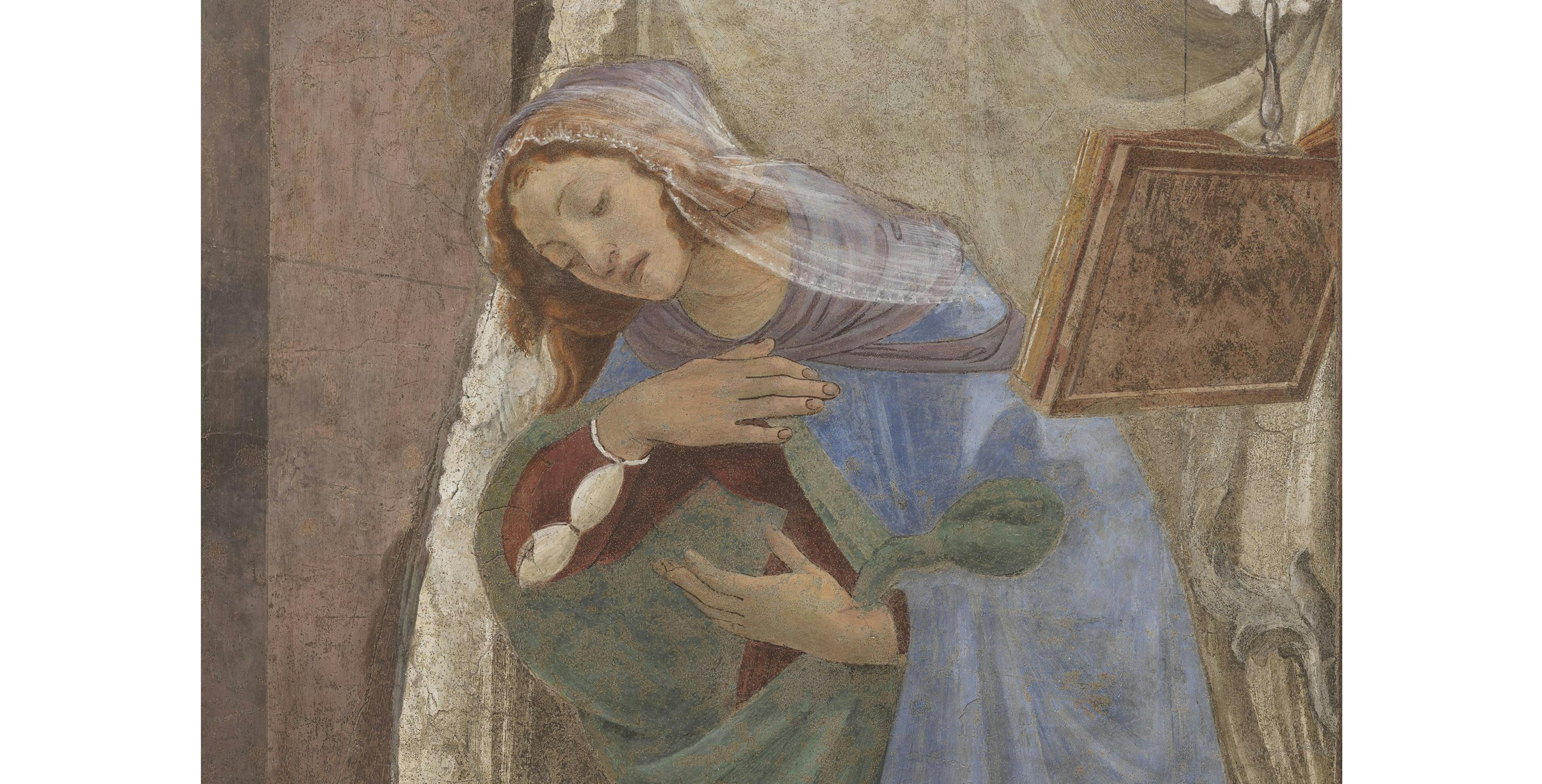
This fresco was painted for the Church of San Martino at the Spedale di Santa Maria della Scala in Florence, a location where abandoned children were taken in. Right away I think: this is why in this masterpiece the Holy Virgin Mary's arms are empty, and she wears a frown! I don't think that in this world there exists a mother who truly wants to leave her child. For sure, there must be an unspeakable reason to do so.
From 1478 to 1479, Florence was struck by a terrible plague, and many of the victims of the epidemic were buried in the monastery attached to the church.
In 1481, Botticelli was paid for the creation of an Annunciation, probably a votive offering to the Holy Virgin Mary to celebrate the end of the plague. The background filled with a quiet and beautiful nature, without any disease, could comfort people. The angel could bring them good news.
I do not believe it is by chance that the angel's point of view is the one from which to admire the entire scene. The fresco was located in the loggia in front of the church entrance, right on top of the door, and the angel was seen right in the centre by those who entered.
It was the Annunciazione, and not the Spring that struck me when I entered this room. Its light and transparent colours gave me a sense of peace; the wide-open space made me breathe.
The house of Mary overlooks this space. It is a rich household, that of a wealthy family. In the shadows of the room there is a very clean and well-made bed, too much so: I would not like to sleep on this bed. I really like instead the space between Mary and the angel, the colour and geometric shapes of the marble, the air that moves through the arches.
Natural light filters through the enclosed garden, and beyond, a landscape.
The landscape reminds me of my city, Guizhou, located in a province half of which is covered by forests. This work really makes me feel nostalgic for my country.
In China I lived with my family in a skyscraper. The apartment was large, but from our windows you could only see the windows of the skyscraper in front of you. It's unpleasant to not see an open view.
If I had a house like this, with an open and private space, it would be perfect.
However, if I were living alone, in such a big space, I would not be happy. Just as my father and mother feel the house is silent since I left.
In Florence, my partner and I live in a home with a terrace that looks out onto a large garden. It is an open space, but where no one can see us. On summer evenings, we have candlelit dinners. It is a location to be lived intimately. I feel free in this location that is truly mine.
I look at the Holy Virgin Mary in the fresco. She looks a bit sad and solitary. The canopy, the oriental-style carpet and lectern create a space of her own, where Mary can feel close to God.
Her arms, like in a dance, seem to create a space for a child who is not there yet.
The light veil touches Mary’s hair. How beautiful she is! The drapery of her cloak, folded over her arm. The white of her shirt that stands out under the sleeve. The colours of her dress, blue and red.
A door, which is not material but imaginary, has just opened in front of her. A light and a strange wind accompany the arrival of the angel. His feet have not yet touched the ground.
He has a mute expression. In the arms crossed on his chest, he holds a white lily, a symbol of purity, in a gesture of adoration. The news that he is bringing to Mary travels through the light.
In the distance between the angel and Mary, I immediately felt how remote/faraway my family is.
Every time I travel, I send a postcard to my mother. She collects them all in a box. They are important to create a memory, a story we can share; otherwise, not much would remain of these years spent far away from each other.
The postcards do not always arrive in the order in which I sent them; some get lost, but this is not important. In this world, nothing is perfect.
The angel comes to bring news about me to my family.
The angel will then leave. The door closes behind him, and Mary will be alone again.
The environment in which Mary lives is open, full of air.
The precious marble patterns of the floor make the scene even dreamier, of idyllic beauty; it does not seem real.
An ideal world, but one that is not so difficult to find. A world within reach, if only we were able to give ourselves space and time.
This home has no doors, nature is near, and there is a garden, Mary's shelter.
Outside there is no one.
In the distance, the poetry of nature.
It will soon be dusk.
Text by Diana Kong
Voice by Lucilla Giagnoni
Artwork detailsAnnunciationPainting | The Uffizi - 8/24Sandro Botticelli, Annunciation (detached fresco)
I look at the Holy Virgin Mary in the fresco. She looks a bit sad and solitary. The canopy, the oriental-style carpet and lectern create a space of her own, where Mary can feel close to God.
Her arms, like in a dance, seem to create a space for a child who is not there yet.
The light veil touches Mary’s hair. How beautiful she is! The drapery of her cloak, folded over her arm. The white of her shirt that stands out under the sleeve. The colours of her dress, blue and red.
A door, which is not material but imaginary, has just opened in front of her. A light and a strange wind accompany the arrival of the angel. His feet have not yet touched the ground.
He has a mute expression. In the arms crossed on his chest, he holds a white lily, a symbol of purity, in a gesture of adoration. The news that he is bringing to Mary travels through the light.
In the distance between the angel and Mary, I immediately felt how remote/faraway my family is.
Every time I travel, I send a postcard to my mother. She collects them all in a box. They are important to create a memory, a story we can share; otherwise, not much would remain of these years spent far away from each other.
The postcards do not always arrive in the order in which I sent them; some get lost, but this is not important. In this world, nothing is perfect.
The angel comes to bring news about me to my family.
The angel will then leave. The door closes behind him, and Mary will be alone again.
The environment in which Mary lives is open, full of air.
The precious marble patterns of the floor make the scene even dreamier, of idyllic beauty; it does not seem real.
An ideal world, but one that is not so difficult to find. A world within reach, if only we were able to give ourselves space and time.
This home has no doors, nature is near, and there is a garden, Mary's shelter.
Outside there is no one.
In the distance, the poetry of nature.
It will soon be dusk.
Text by Diana Kong
Voice by Lucilla Giagnoni
Artwork detailsAnnunciationPainting | The Uffizi - 9/24Sandro Botticelli, The Cestello Annunciation and Pietà
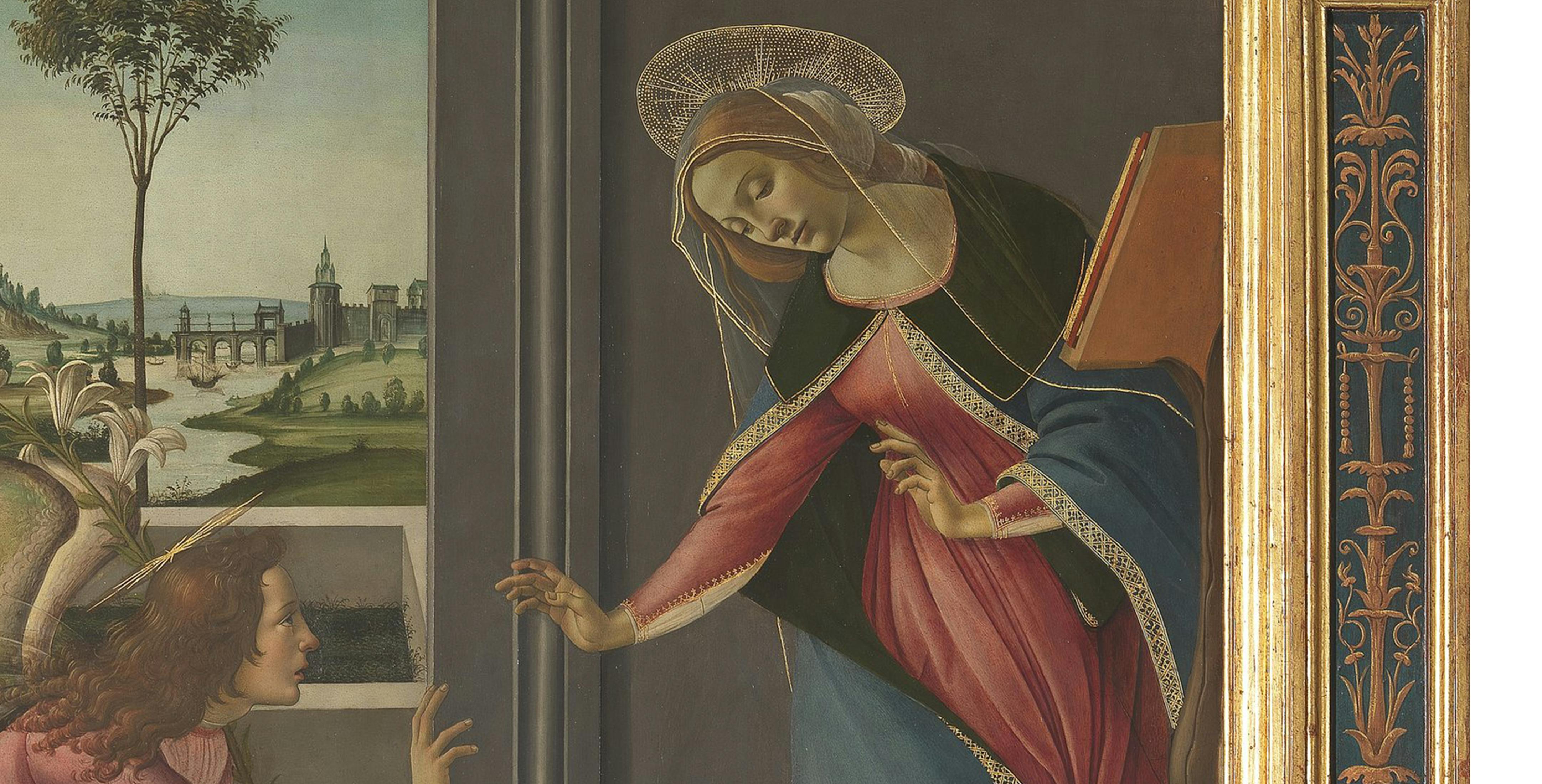
The hands are suspended in space, as if waiting for something.
The angel has just arrived. A puff of wind seems to pass through his light veil. Like conception, like life: a gasp, a breath.
He kneels, a hand outstretched towards Mary to reassure her: “I come in peace”. In his other hand, a lily, the symbol of purity.
Mary, distracted from her reading, almost turns upon herself; her gaze is turned inwards, as if listening, listening to the heartbeat. One hand says “wait”, the other is level with her heart.
It takes time to take in a piece of news; it is time that gives us the ability to take in emotions, to understand them.
The announcement will change the Virgin: life changes with a child.
The life growing inside you brings immense emotions with it. You are no longer alone; there is someone living inside you, in the perfect home, your womb.
When I was expecting my daughter, I was not alone; she lived perfectly inside me and had everything she needed through me. Wait! Wait! I’m not ready! Perhaps I am enough for you now, but later, when they separate us? When I am no longer your perfect dwelling place? What will become of me? Or you? Who will protect us? Wait!
One needs time to understand, to accept. For example, with time, I realized that in certain circumstances of my life, I was scared that when someone gave me something, they could take it away again.
Mary accepts her son, and she accepts her pain too, as foreshadowed in the image of the Pietà in the bottom of the frame.
It is difficult to accept what can be taken away.
Here, where the angel has just landed, we find ourselves in an enclosed space, in the shelter of a home.
The room where the scene takes place is rather bare. It does not look like a holy space; it is a real house, a noble dwelling, judging by the fine materials.
Gabriele, silhouetted against the rectangle of the door, is in some way outside Mary’s domestic space; at the same time, by bursting into the house, he brings the breath of God into a human space.
Mary’s womb contains divine life and breath; it is a perfect home, but with time, it will inevitably become too small. Perhaps we are all seeking the perfect house, but even the other houses where we live, not just our mother’s womb, push us out at a certain point.
I have had to move home several times during my life. I often dreamed of going into semi-demolished houses, that I would burn down and then rebuild from the foundations up. I was only at peace when I could afford a home with a room for each of my children. Now my home has a garden, full of light, color, trees and life.
Behind the angel, there is a door, with glimpses of a walled garden, which is an attribute of the Virgin, a reference to her purity, and also a magnificent imaginary view.
Botticelli has painted a young tree in the middle.
Some experts think it is an ash, a Marian plant which is lethal to snakes in the same way as the Virgin is lethal to the devil.
Other academics see it as an oak. I like to think it is. Its roots can emerge from the soil and re-enter it in more distant places, drawing ever more strength. It is considered a holy tree, linked to the family and fertility. It stands for solid protection and the strength to survive the hardest of times.
This Annunciation is from Botticelli’s later period, painted during a religious crisis triggered by the preaching of Girolamo Savonarola, the Dominican friar who played a leading role in expelling the Medici from Florence and in the establishment of the Republic in 1494. His sermons profoundly affected the artist who for years had been the leading exponent of the elegant, neo-Platonic culture promoted by the Medici and their entourage. Here, in this austere space, the figures of the Virgin and the angel are animated by a spiritual tension not found in Botticelli’s previous works.
After various vicissitudes, the painting, which had originally been painted for the Church of Cestello, arrived in the Uffizi in 1872.
That same Gallery of Paintings and Statues is where I began to work as a museum guard in 1986. But I didn’t look at the artworks; I was too much in pain.
I really became aware of the Cestello Annunciation when I was asked to choose a work, and this made me start looking at paintings and statues in a different way. I felt something in those hands, which Mary holds as if protecting her heart. The baby’s heart, the first thing detected in a scan. It’s the only thing you see, a breath, a beat... That is why I chose this painting, or it chose me, because after all, artworks reflect our emotions, they resemble us, and call on us to weave our stories with theirs.
Text by Fabiana Bianchini
Voice by Maria Paiato
Artwork detailsAnnunciationPainting | The Uffizi - 10/24Sandro Botticelli, The Cestello Annunciation and Pietà
Mary’s womb contains divine life and breath; it is a perfect home, but with time, it will inevitably become too small. Perhaps we are all seeking the perfect house, but even the other houses where we live, not just our mother’s womb, push us out at a certain point.
I have had to move home several times during my life. I often dreamed of going into semi-demolished houses, that I would burn down and then rebuild from the foundations up. I was only at peace when I could afford a home with a room for each of my children. Now my home has a garden, full of light, color, trees and life.
Behind the angel, there is a door, with glimpses of a walled garden, which is an attribute of the Virgin, a reference to her purity, and also a magnificent imaginary view.
Botticelli has painted a young tree in the middle.
Some experts think it is an ash, a Marian plant which is lethal to snakes in the same way as the Virgin is lethal to the devil.
Other academics see it as an oak. I like to think it is. Its roots can emerge from the soil and re-enter it in more distant places, drawing ever more strength. It is considered a holy tree, linked to the family and fertility. It stands for solid protection and the strength to survive the hardest of times.
This Annunciation is from Botticelli’s later period, painted during a religious crisis triggered by the preaching of Girolamo Savonarola, the Dominican friar who played a leading role in expelling the Medici from Florence and in the establishment of the Republic in 1494. His sermons profoundly affected the artist who for years had been the leading exponent of the elegant, neo-Platonic culture promoted by the Medici and their entourage. Here, in this austere space, the figures of the Virgin and the angel are animated by a spiritual tension not found in Botticelli’s previous works.
After various vicissitudes, the painting, which had originally been painted for the Church of Cestello, arrived in the Uffizi in 1872.
That same Gallery of Paintings and Statues is where I began to work as a museum guard in 1986. But I didn’t look at the artworks; I was too much in pain.
I really became aware of the Cestello Annunciation when I was asked to choose a work, and this made me start looking at paintings and statues in a different way. I felt something in those hands, which Mary holds as if protecting her heart. The baby’s heart, the first thing detected in a scan. It’s the only thing you see, a breath, a beat... That is why I chose this painting, or it chose me, because after all, artworks reflect our emotions, they resemble us, and call on us to weave our stories with theirs.
Text by Fabiana Bianchini
Voice by Maria Paiato
Artwork detailsAnnunciationPainting | The Uffizi - 11/24Sandro Botticelli, Spring
This garden is like paradise.
An earthly paradise where everything had meaning, before the arrival of man.
I tried to imagine this meadow, empty. No one has yet set foot in it.
The variety of flowers is immense. Everything is precise, perfect, unspoiled.
One is almost afraid to enter and to tread on such beauty.
Every detail contributes to the whole. Every element that contributes to the whole brings with it a story and a precise meaning.
In my eyes, all this takes on an extraordinary affinity with African spirituality: at its center is the harmony that covers everything , nature as a divinity that may be found in the trees, the plants, the river, the sun and the wind. That same wind that here, in the Spring by Botticelli, puffs out the clothes, fertilizes the plants and gives origin to life. A breath of life that permeates everything.
The Spring is considered a masterpiece of profane art, yet I find it has a strong spiritual and religious dimension.
I start to move across the meadow, stopping at the edge of the woods that become thicker and thicker, taking me back to my childhood. The slender, straight trunks of the orange trees slowly become more and more imposing as I enter, creating darkness around me. I am nine years old. It’s four in the morning; the air is cool. I can hear the noise of the water flowing, the birdsong. My uncle is holding the hand of Eugène, my youngest brother, who needs care. He starts to speak in a language I don’t know, because the ritual needs words other than everyday language.
Not everyone enters the sacred woods. That wood is a place that needs utmost silence, utmost respect, because it’s where one goes to meet the gods, because one goes there to speak with plants.
This wood, too, is a sacred space. A space ready to welcome divine presences.
A gust of wind and a celestial winged creature bursts onto the scene: Zephyr, the warm west wind. With his breath of life, he fertilizes the nymph Cloris, who is transformed into Flora. Venus appears in the center, the goddess of beauty, love and fertility. Above her, her son Cupid is flying, ready to fire off his arrow. The wave-like movement continues with the group of the three Graces, intertwined in a gentle dance, and ends with Mercury: with his winged staff, he chases off the clouds that threaten the end of spring.
The mythological characters are easily identifiable. It is the meaning of their meeting that has given rise to infinite interpretations, many of which are linked to the Medici family, who commissioned the Spring. Some academics have stressed the political interpretation of the work as a celebration of Florence flourishing under their rule.
On a level of philosophical interpretation, what it shows us is the journey to perfection of the soul, which also alludes to the Medici, patrons of the neo-platonic Academy.
Zephyr is the more irrational, sensual power of love: thanks to the mediation of Venus, it is transformed into a higher form of love, represented by the Three Graces, who symbolize the love that is given. Finally, Mercury chases away the clouds and aims for supreme perfection, that of the heavens.
My gaze returns to the meadow, to the feet of these three ethereal girls dancing.
It is such a perfect dance as to seem completed. Yet this is the point of the painting that invites me to enter.
I would enter in small steps, hesitating like I did as a child, imitating the grown-ups. At a certain point, you find yourself inside the circle. Bare feet pressing firmly down on the ground. You begin doing what the others do, and you manage it, and you become part of that circle. The dance was held once a year, when the village was lit by the full moon, and it followed a precise ritual: to implore gods, to chase out sickness and bring in health but, at the same time, to explain the roundness of the earth, the central position of human beings.
Different gestures, different contexts, but is it so far removed from the man who was lord of all things, celebrated in Florence during the 15th century?
It is not possible to remain in the sacred woods, the woods of Venus, but whatever is learned there can be taken with you.
And it is a shame for those who did not know how to walk through it...
Text by Kuassi Sessou
Voice: Marco Baliani
Music: Gabin Dabiré
Artwork detailsSpringPainting | The Uffizi - 12/24Sandro Botticelli, Spring
My gaze returns to the meadow, to the feet of these three ethereal girls dancing.
It is such a perfect dance as to seem completed. Yet this is the point of the painting that invites me to enter.
I would enter in small steps, hesitating like I did as a child, imitating the grown-ups. At a certain point, you find yourself inside the circle. Bare feet pressing firmly down on the ground. You begin doing what the others do, and you manage it, and you become part of that circle. The dance was held once a year, when the village was lit by the full moon, and it followed a precise ritual: to implore gods, to chase out sickness and bring in health but, at the same time, to explain the roundness of the earth, the central position of human beings.
Different gestures, different contexts, but is it so far removed from the man who was lord of all things, celebrated in Florence during the 15th century?
It is not possible to remain in the sacred woods, the woods of Venus, but whatever is learned there can be taken with you.
And it is a shame for those who did not know how to walk through it...
Text by Kuassi Sessou
Voice: Marco Baliani
Music: Gabin Dabiré
Artwork detailsSpringPainting | The Uffizi - 13/24Sandro Botticelli, Pallas and the centaur
Before my eyes, luxuriant green hills and a cool blue river rippled by the peaceful bobbing up and down of a solitary ship. The peak where I was sitting was a dark rock that extended upwards. I was watching my feet swing over the emptiness, when I heard a rumble from the other side of the hill. I raised my head and looked out over the horizon. The noise became more and more intense, when, out of a cloud of dust, I saw the disturbing, disconnected gallop of a centaur. The speed with which he reached the rock made me think that perhaps he would end up against it, but he turned with a skilful manoeuvre of his hooves. He began to skirt the stone wall with a light trot, but finding no escape route, he stopped. It was if he were seized by a wild anger, pawing, galloping and pacing like a caged animal. The striking of his hooves on the ground marked the passage of the seconds towards something inexorable, when he grabbed his bow, took an arrow from its quiver and, nocking it, pointed it towards the ground. He kept his eyes fixed on the horizon, forcing me to do the same.
Then I saw her, on the crest of the hill, moving forwards slowly and threateningly, like a cat about to pounce. The solid gold halberd in her left hand did not seem to weigh her down at all. The wind was having fun creating small silky whirlpools on her clothes, whipping them around her legs and causing her hair to dance around the milk-white skin of her face, neck, chest and shoulders. However, it was her eyes, pale grey and magnetic, that conveyed the true fascination of the woman: serene yet threatening; proud and wise, but humble. Just a few centimetres from the centaur, who suddenly appeared docile and defenceless, the enigmatic woman stared at him in silence and then, slowly, raised her right arm, extending her slender fingers towards her rival’s head, as if she wanted to caress his wild brown hair, but he withdrew, in fear. Only then did the warrior speak: “Why do you move away, centaur? Do I disgust you, perhaps? Or do you fear me?”
The centaur straightened up in an attempt to recover some dignity, but he answered nervously: “How could you ever disgust me, oh Pallas Athena? None among the stars in the heavens can compete with your beauty. No, I am afraid, my goddess, not of you, nor for my life, but for my freedom. I love to live by my instinct, and to please my senses beyond all limits. But I cannot do so, if I am not free of you. So why do you persecute me? Have I perhaps offended you?”
Athena did not answer immediately. For a few seconds, it seemed as if the world were suspended, then she spoke: “There was once a man, a philosopher and Greek scholar, my protégé. Plato was his name. I will tell you the story he told the world, Centaur. After death and before life, the soul has a moment of reminiscence in which it appears as a chariot, pulled by a pair of horses and driven by a charioteer. The black horse is lustful and instinctively moves downwards, towards reincarnation. The white horse is spiritual and moves upwards, to the Hyperuranion. It is the charioteer’s task to raise the chariot towards ideas: the more skilled he is in this undertaking, the greater the soul’s knowledge will be once it returns to life. Mine is not a persecution, Centaur. Both the black and the white horse trot around, roving inside you. What you call freedom is actually the submission of your spirituality to the passions that keep you chained to Earth and do not allow you to reach the stars, that you worship from afar. I am here not to take away your passions, but to help you to find balance; if you accept my guidance, I will be the charioteer who takes you to greatness”. I waited for the Centaur's answer but all I heard was silence. The Centaur had gently bowed his head to Athena. The goddess took his hair with a gentle strength, harnessing it in a soft, yet firm grip. She took him out from the shadow of the stone and towards the horizon, illuminated by the sun, and thus the two figures disappeared.
I stayed there, immobile, ecstatically affected by the scene I had just witnessed as an invisible presence. I quickly climbed down the rock face and began to run: I crossed the country landscapes and reached the high walls of the city and the narrow winding streets of Florence. I pushed the heavy wooden door into the master’s workshop. “Master Botticelli!” I called out loudly. He was sitting before a canvas covered by white cloth. When he heard me, he turned around, his eyebrows raised, an interrogative expression on his face. “You have no idea what I’m about to tell you”, I said. I told him about the meeting between Pallas and the Centaur, which I had seen from above. At the end of my story, my master’s eyes were wide open and he did not say a word. He simply raised the white cloth covering the mysterious canvas, revealing Pallas’ ethereal beauty and the goddess immortalized in the act of seizing the Centaur's hair between her white hands. I was open mouthed. “How can this be possible?” I asked, shocked. The master answered, thoughtfully: “Some time ago, Lorenzo de’ Medici commissioned a painting that would convey the political image of his family. Having no idea how to start, I found myself wandering over the same peak you have just told me about, in search of inspiration. That is when I saw the triumph of Athena over the Centaur. The surreal vision ended the questions that tormented me. Athena was the clearest example of a power that does not dominate, but which guides. A power that brought order back to the Centaur’s soul, just as the Medici brought peace to Florence. Thus, to the olive branch ornaments, the symbol of the goddess and of Christian peace, I added some rings with a diamond, the symbol of the Medici, those who maintain harmony in the city. I was thinking that I could create a connection between this and my last piece; do you remember the Spring?” “And how could I forget it?” I thought. “After all, veneration of natural beauty goes hand in hand with the search for truth, don’t you think?”
He suddenly stopped and smiled at me. It looked as though he had been seized by a playful compassion for me. “I think I have been rambling a little too much. You must also have had some doubt when you went up to that peak. What could be so important as to afflict your young mind, to bother that poor Centaur and the divine Athena?”
Ignoring his condescending tone, I started to think, when the answer came to me clearly. “Sir, it is difficult to say in words what was tormenting me on the top of that precipice. For years I have been dragging a beast inside me, that’s what I call it, which pushes me to do magnificent things, because it nourishes and excites my creativity. I could not be without it. It is my sensitive, instinctive and emotional soul. But not only is my beast out of control, it seems able to overwhelm me, amplifying my feelings to excess.
I have no wish to chain or repress this creature. I would just like it to cease spiking my insides, opening bleeding wounds that cannot heal. I would like it to flow, harmoniously, like a stream, unstoppable but balanced and vital.
Athena honoured me with her presence, perhaps, because of what I aspire to become: a woman who lives her passions, but who does not let these overwhelm her. Like Athena with the centaur, I need to find the strength to guide this inner animal with the same resolute grace, or it will continue to make me suffer, as well as those around me.
My passionate monologue must have affected Botticelli, who looked at me with a touch of melancholy.
I smiled with tears in my eyes: probably, he knew something about this too.
Text by Sofia Kossiwa Sessou
Voice by Lella Costa.
Artwork detailsPallas and the CentaurPainting | The Uffizi - 14/24Sandro Botticelli, Pallas and the centaur
Athena did not answer immediately. For a few seconds, it seemed as if the world were suspended, then she spoke: “There was once a man, a philosopher and Greek scholar, my protégé. Plato was his name. I will tell you the story he told the world, Centaur. After death and before life, the soul has a moment of reminiscence in which it appears as a chariot, pulled by a pair of horses and driven by a charioteer. The black horse is lustful and instinctively moves downwards, towards reincarnation. The white horse is spiritual and moves upwards, to the Hyperuranion. It is the charioteer’s task to raise the chariot towards ideas: the more skilled he is in this undertaking, the greater the soul’s knowledge will be once it returns to life. Mine is not a persecution, Centaur. Both the black and the white horse trot around, roving inside you. What you call freedom is actually the submission of your spirituality to the passions that keep you chained to Earth and do not allow you to reach the stars, that you worship from afar. I am here not to take away your passions, but to help you to find balance; if you accept my guidance, I will be the charioteer who takes you to greatness”. I waited for the Centaur's answer but all I heard was silence. The Centaur had gently bowed his head to Athena. The goddess took his hair with a gentle strength, harnessing it in a soft, yet firm grip. She took him out from the shadow of the stone and towards the horizon, illuminated by the sun, and thus the two figures disappeared.
I stayed there, immobile, ecstatically affected by the scene I had just witnessed as an invisible presence. I quickly climbed down the rock face and began to run: I crossed the country landscapes and reached the high walls of the city and the narrow winding streets of Florence. I pushed the heavy wooden door into the master’s workshop. “Master Botticelli!” I called out loudly. He was sitting before a canvas covered by white cloth. When he heard me, he turned around, his eyebrows raised, an interrogative expression on his face. “You have no idea what I’m about to tell you”, I said. I told him about the meeting between Pallas and the Centaur, which I had seen from above. At the end of my story, my master’s eyes were wide open and he did not say a word. He simply raised the white cloth covering the mysterious canvas, revealing Pallas’ ethereal beauty and the goddess immortalized in the act of seizing the Centaur's hair between her white hands. I was open mouthed. “How can this be possible?” I asked, shocked. The master answered, thoughtfully: “Some time ago, Lorenzo de’ Medici commissioned a painting that would convey the political image of his family. Having no idea how to start, I found myself wandering over the same peak you have just told me about, in search of inspiration. That is when I saw the triumph of Athena over the Centaur. The surreal vision ended the questions that tormented me. Athena was the clearest example of a power that does not dominate, but which guides. A power that brought order back to the Centaur’s soul, just as the Medici brought peace to Florence. Thus, to the olive branch ornaments, the symbol of the goddess and of Christian peace, I added some rings with a diamond, the symbol of the Medici, those who maintain harmony in the city. I was thinking that I could create a connection between this and my last piece; do you remember the Spring?” “And how could I forget it?” I thought. “After all, veneration of natural beauty goes hand in hand with the search for truth, don’t you think?”
He suddenly stopped and smiled at me. It looked as though he had been seized by a playful compassion for me. “I think I have been rambling a little too much. You must also have had some doubt when you went up to that peak. What could be so important as to afflict your young mind, to bother that poor Centaur and the divine Athena?”
Ignoring his condescending tone, I started to think, when the answer came to me clearly. “Sir, it is difficult to say in words what was tormenting me on the top of that precipice. For years I have been dragging a beast inside me, that’s what I call it, which pushes me to do magnificent things, because it nourishes and excites my creativity. I could not be without it. It is my sensitive, instinctive and emotional soul. But not only is my beast out of control, it seems able to overwhelm me, amplifying my feelings to excess.
I have no wish to chain or repress this creature. I would just like it to cease spiking my insides, opening bleeding wounds that cannot heal. I would like it to flow, harmoniously, like a stream, unstoppable but balanced and vital.
Athena honoured me with her presence, perhaps, because of what I aspire to become: a woman who lives her passions, but who does not let these overwhelm her. Like Athena with the centaur, I need to find the strength to guide this inner animal with the same resolute grace, or it will continue to make me suffer, as well as those around me.
My passionate monologue must have affected Botticelli, who looked at me with a touch of melancholy.
I smiled with tears in my eyes: probably, he knew something about this too.
Text by Sofia Kossiwa Sessou
Voice by Lella Costa.
Artwork detailsPallas and the CentaurPainting | The Uffizi - 15/24Giovanni Bellini, Holy Allegory
There is silence. I close my eyes, I am disorientated, confused. I drag my feet over a solid, smooth and extremely cold surface. A floor in the finest marble takes me back to a distant past, when I was a child.
I open my eyes and I am not alone: there are different generations all around me. Women, children, young and old men, crowd onto a large terrace overlooking a lake. It seems like a meeting, but it is not. There are prayers, but people are not looking at one another.
The terrace is fenced, but with an opening leading down to the lake. The doors to my house were always open to everyone too. My father was a generous, welcoming person. He used to say that there was no need to knock or ask to come in, that those who needed help were to feel welcome, listened to, understood.
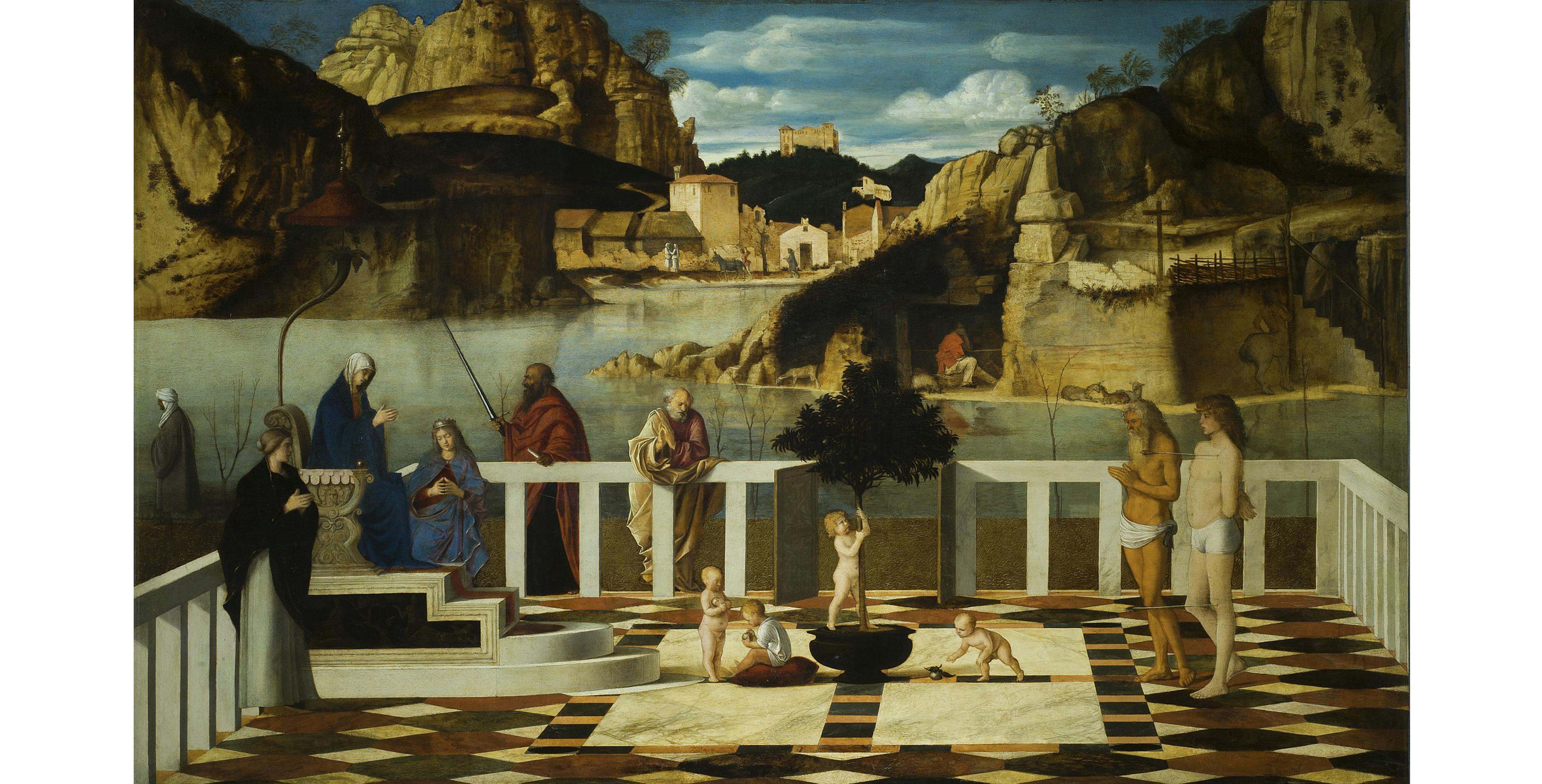
The Holy Allegory by Giovanni Bellini, is one of the most mysterious works in art history.
It is an unusual painting in itself. When it was painted, at the end of the 15th century, profane allegories were widespread, but holy ones were non-existent. Like the life of every individual, this artwork is unique, without comparison.
We are in an indefinite, “suspended” time.
Who these mysterious figures are, we cannot say with any certainty. For more than a century, art historians have been racking their brains in the attempt to interpret a painting that, in the intention of the person who commissioned it, should have been understood only by a close circle of well-read people.
Of the many hypotheses proposed, the one I find most fascinating was formulated by academic Gustav Ludwig, who, in 1902, interpreted the terrace as the Garden of Eden. This is the start of the journey into Heaven of the soul, represented by the child who is dressed and sitting on a cushion. The soul is waiting to be judged by the Virgin, the saints behind her and the allegory of Justice, represented by the woman wearing a crown, standing to Mary’s left. The two persons standing on the right are identified as saints, patrons of the soul before the celestial court. On the other side of the terrace, the landscape seems to allude to the route taken by the soul to flee vice (represented by the centaur tempting the hermit) and, finally, to arrive in Heaven thanks to virtues such as patience, humility and abstinence, as represented by the donkey, the flock of sheep and the goat.
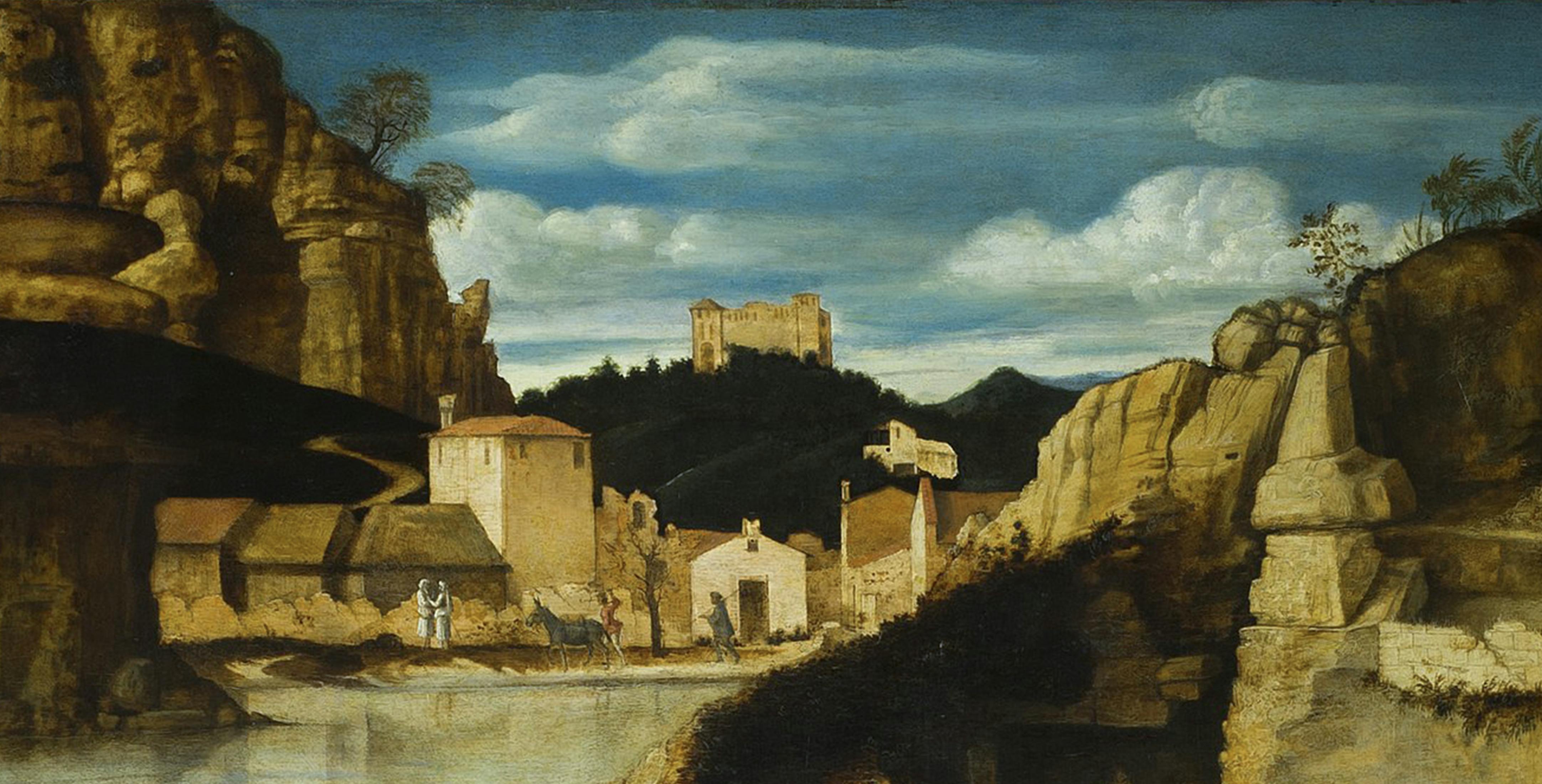
There is nothing exotic in the scene that Bellini paints on the other side of the lake. If there is such a thing as an extraneous, “different” place, it is the terrace. And yet, this is where the passage from non-communication to communication is played out. What will happen when the figures begin to act? Will Mary raise her eyes first, triggering the event that everyone is waiting for? Or will the child on the cushion stand up?
I had trouble communicating too, but I had a power inside: the encounter with my husband. We met through letters; he knew I was Berber like him, because I lived in a small town near Agadir.
Our journey was made of many sacrifices, I grew with him.
I never stopped studying, “asking knowledge”, as we say in Arabic. The student is the “one who asks”. Along the way, I rediscovered something my father had taught me: the importance of keeping doors open. And so I became a mediator. Facilitating encounters, relationships, mutual knowledge and exchanges became my profession.
Like the clear, peaceful water of this lake, which is a chromatic link between the terrace and the bank on the opposite side, leading to the sheer rocks over the water, to the village and the castle towering over the dense woods.
Then, there are the mountains, which I often dream about at night. I dream of climbing impervious paths, which is a bit like life. But in the end, I always manage to reach my destination. And when I get to the top, I know that I have made it.
I open my eyes. Mary lifts her gaze, and the conversation begins.
Text by Samira Lahhane
Voice by Micaela Casalboni
Artwork detailsHoly allegoryPainting | The Uffizi - 16/24Giovanni Bellini, Holy Allegory
There is nothing exotic in the scene that Bellini paints on the other side of the lake. If there is such a thing as an extraneous, “different” place, it is the terrace. And yet, this is where the passage from non-communication to communication is played out. What will happen when the figures begin to act? Will Mary raise her eyes first, triggering the event that everyone is waiting for? Or will the child on the cushion stand up?
I had trouble communicating too, but I had a power inside: the encounter with my husband. We met through letters; he knew I was Berber like him, because I lived in a small town near Agadir.
Our journey was made of many sacrifices, I grew with him.
I never stopped studying, “asking knowledge”, as we say in Arabic. The student is the “one who asks”. Along the way, I rediscovered something my father had taught me: the importance of keeping doors open. And so I became a mediator. Facilitating encounters, relationships, mutual knowledge and exchanges became my profession.
Like the clear, peaceful water of this lake, which is a chromatic link between the terrace and the bank on the opposite side, leading to the sheer rocks over the water, to the village and the castle towering over the dense woods.
Then, there are the mountains, which I often dream about at night. I dream of climbing impervious paths, which is a bit like life. But in the end, I always manage to reach my destination. And when I get to the top, I know that I have made it.
I open my eyes. Mary lifts her gaze, and the conversation begins.
Text by Samira Lahhane
Voice by Micaela Casalboni
Artwork detailsHoly allegoryPainting | The Uffizi - 17/24Camillo Boccaccino, Head of Old Man
He brought me here.
We met in the Gallery on a November afternoon, in the room where I was working. He was immersed in his thoughts, and I in mine.
Just a few tourists in the rooms and corridors, and a calm atmosphere in the shadowy autumn light.
I looked up and saw him. I had never met him, yet he was there, where he had always been.
This is what happens when there is so much beauty all around you.
Then, a second of harmony, which is like a small jolt for you... And there it was, that bent head of an old man.
A prophet? A saint? A wise man?
Like a gush of water, for me, he is my grandfather, Armando.
An elementary schoolteacher with a passion for Greek and Latin, just a few things in his backpack, including War and Peace by Tolstoy and, on the day after 8th September 1943, the long walk home, from Rome to Sicily.
As I said, it was he, with his love of beauty, who brought me here to Florence.
So why was I so struck by a painting in Lombard style? After all, the artist, Camillo Boccaccino, is almost unknown, and his city, Cremona, is not 16th-century Florence.
Why this old man’s head, out of all the masterpieces in the Uffizi?
Because for me, this face has no identity of its own, and anyone can give it some emotional tie. A slight memory that is timid and powerful at the same time.
We know almost nothing about the painting; it could be a preparatory study for an altarpiece never executed, but it looks more like a fragment.
We also know very little about the artist. Very few of his works remain: four altarpieces, of which one has been lost, and frescoes in the church of San Sigismondo and the Cathedral, both in Cremona.
And then, this portrait of an old man, with all its mystery.
A palette played out in the colour tones that art historian Mina Gregori, also Cremonese by birth, describes as: “a range of autumn fire; a bonfire of crisp, dry leaves”.
How did Boccaccino achieve these colours?
With light.
Yes, light! I’ll try to follow it.
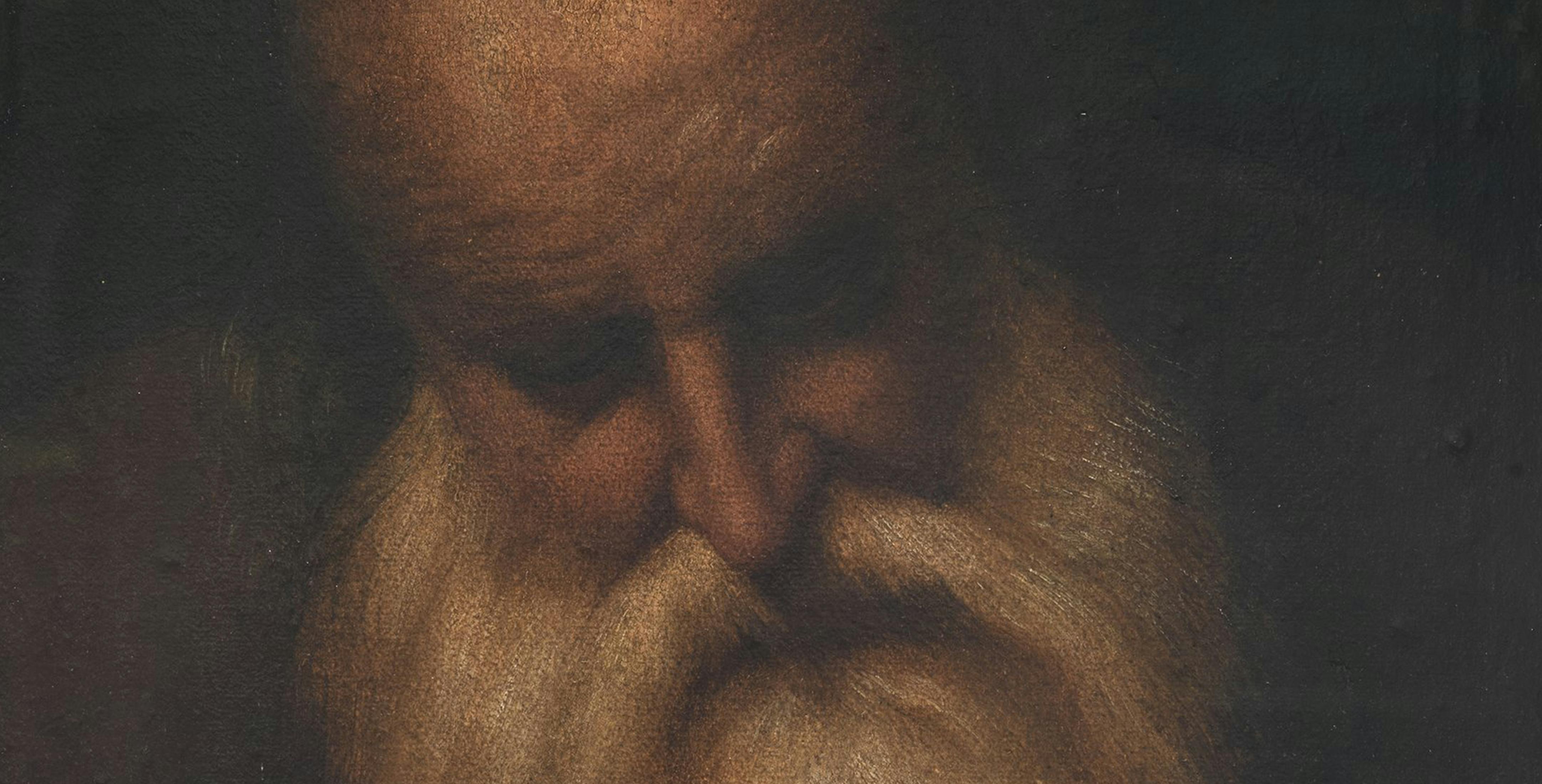
It comes from above, lighting the receding hairline, and not by chance: the forehead is where knowledge resides.
The man is looking downwards; he frowns, as if his quiet mind had just been enlightened by a sudden thought.
His eyes are barely perceivable; they are in shadow because the light is shining straight on the thick white beard, which is almost eaten away by the darkness at the bottom.
Wrinkles, like the waves on the sea after a storm, seem to fade around the barrier of the eyebrows, and there is a worry line to mark the boundary between the forehead and the long, regular nose, almost like the tip of an arrow.
The expression is friendly, the intention gentle, like a tender, awkward St. Joseph.
He has the tenderness of the elderly on his face; the same tenderness that makes me think of my grandfather.
A memory that merges with the light, like colour merges with shadow in Camillo Boccaccino.
It’s summer. I am going into my grandparents’ house in the village. It’s a large, old house.
The silence of an early afternoon in the sun. The sound of the cicadas. An antechamber bathed in sunlight, giving cool shade to the other rooms in the home.
I move forward from the heat into the dim dining room, where there is a large table in dark wood, protected by a thick green sheet of glass. The light filters from the antechamber.
He isn’t here, though. I find him writing at his desk, strictly in pencil, in a small room invaded by warmth and silence. The blinding light is kept back by a fine embroidered curtain, white and swollen like the sails on a boat. Darkness and light. The feathery pencil strokes and the neat handwriting of the teacher. Soft, gentle expressions such as: “You look very well today, my sweet granddaughter!”. The smell of books with yellowing pages and lovely illustrations. A world would open up to me in those moments.
Today, this is just a memory, and it seems strange that a nameless old man’s head could unleash so many remembrances and soften my gaze over so many dormant things.
It was my grandfather who brought me here, before this face, so that this face would take me back to him.
Text by Maria Spanò
Voice by Arianna Scommegna.
Artwork detailsPortrait of an Old ManPainting | The Uffizi - 18/24Camillo Boccaccino, Head of Old Man
And then, this portrait of an old man, with all its mystery.
A palette played out in the colour tones that art historian Mina Gregori, also Cremonese by birth, describes as: “a range of autumn fire; a bonfire of crisp, dry leaves”.
How did Boccaccino achieve these colours?
With light.
Yes, light! I’ll try to follow it.
It comes from above, lighting the receding hairline, and not by chance: the forehead is where knowledge resides.
The man is looking downwards; he frowns, as if his quiet mind had just been enlightened by a sudden thought.
His eyes are barely perceivable; they are in shadow because the light is shining straight on the thick white beard, which is almost eaten away by the darkness at the bottom.
Wrinkles, like the waves on the sea after a storm, seem to fade around the barrier of the eyebrows, and there is a worry line to mark the boundary between the forehead and the long, regular nose, almost like the tip of an arrow.
The expression is friendly, the intention gentle, like a tender, awkward St. Joseph.
He has the tenderness of the elderly on his face; the same tenderness that makes me think of my grandfather.
A memory that merges with the light, like colour merges with shadow in Camillo Boccaccino.
It’s summer. I am going into my grandparents’ house in the village. It’s a large, old house.
The silence of an early afternoon in the sun. The sound of the cicadas. An antechamber bathed in sunlight, giving cool shade to the other rooms in the home.
I move forward from the heat into the dim dining room, where there is a large table in dark wood, protected by a thick green sheet of glass. The light filters from the antechamber.
He isn’t here, though. I find him writing at his desk, strictly in pencil, in a small room invaded by warmth and silence. The blinding light is kept back by a fine embroidered curtain, white and swollen like the sails on a boat. Darkness and light. The feathery pencil strokes and the neat handwriting of the teacher. Soft, gentle expressions such as: “You look very well today, my sweet granddaughter!”. The smell of books with yellowing pages and lovely illustrations. A world would open up to me in those moments.
Today, this is just a memory, and it seems strange that a nameless old man’s head could unleash so many remembrances and soften my gaze over so many dormant things.
It was my grandfather who brought me here, before this face, so that this face would take me back to him.
Text by Maria Spanò
Voice by Arianna Scommegna.
Artwork detailsPortrait of an Old ManPainting | The Uffizi - 19/24Domenico Ghirlandaio, Adoration of the Magi
I was born on my father’s land, in the country.
An immense estate, covering 260 hectares. One part was in the hills, the rest was green meadowland, where his livestock grazed.
There were three small communities around my father’s land. Sometimes the people who lived there would go to him to ask for a piece of land to cultivate, and my father would offer it for free. He recognized this need for land; his own was large enough to have some to give away.
When my father butchered a cow, everyone was invited. It was a great celebration; a time for meeting, when people could exchange stories, talk about problems in the community, ask for advice.
Also in this painting, executed by Ghirlandaio, there is a meadow. It opens out behind the figure of Mary, almost an empty space to emphasize her presence.
The three wise men have just placed their signs of wealth on the ground.
The youngest one is still removing his necklace, while a page gently removes his crown.
The Child raises his hand to bless the oldest king, who kisses his foot as a sign of devotion.
The crowded procession that accompanies the Magi is arranged in a circle on both sides, as if following the round shape of the painting and emphasizing the importance of Mary and the Child.
In the background, a hut inside the ruins of a temple symbolizes the advent of the time of grace overcoming the ancient law, the Old Testament. Just like a slender bud that is finding its way.
And further away, a port. Perhaps this is where the Magi arrived to worship the Child.
Sky, land, sea... a limitless space.
In the 15th century, the episode described in the Gospel of St. Matthew became an occasion to celebrate the wealth and power of art patrons. Domenico Bigordi, known as ‘Il Ghirlandaio’, probably executed this round painting for the Tornabuoni family. The round shape of the work made it rather unsuitable for the altar of a church, and in fact it was made for the Tornabuoni to worship in their own home.
Representatives of the family are portrayed with great precision in the two men kneeling to the right, and perhaps even the Magus turned towards us. A sort of family reunion.
Then, there is Joseph, absorbed in a marvelous tender look directed towards Mary. A little apart from the others, his face resting on his hand, he contemplates his wife and child.
The figure of Joseph reminds me of my father.
He was always so protective of me. I was the youngest; the last of five children.
But he wasn’t able to protect me against the assault occurred when I was a girl, nor against my fear of possible revenge when the trial ended in my favor.
My father didn’t want me to go away, but I was sure I could no longer live in Peru. I’m the one who decided to leave, to change my life...
The day I left for Europe, my father watched me from a distance. He didn’t say goodbye; he didn’t want me to leave.
In the painting there are a few objects in the foreground, placed on a stone: a case for glasses, a saddlebag, and a water flask, just the essentials for a journey. I pick them up and leave. Without looking back.
I was just 22 when, newly graduated, I decided to face the challenges of a new world alone. I left a familiar place behind me; a wealthy, safe place, to find myself tossed around as an illegal immigrant.
When I came to Florence, it was a turning point: I joined the associations and support groups for new immigrants, became involved in local politics, began to take on new responsibilities.
In this initiatory journey, I passed under the ruins of times past, and crossed through the door of Mercy.
The Magi too, perhaps, passed that way on their return to the East. They were told by an angel not to go back to Herod and so they took a different route home.
A few months ago, I went back to my father’s house in the country. A nephew of mine was getting married. I saw how the family had grown, the children of children, the kids now adults, and many toddlers. There, once again on the large meadow around the house, we had become a great family.
The Magus in the foreground turns towards us, as if surprised by the people who continue to arrive in an endless flow of generations.
Text by Lina Callupe
Voice by Giulia Lazzarini
Artwork detailsAdoration of the MagiPainting | The Uffizi - 20/24Domenico Ghirlandaio, Adoration of the Magi
Then, there is Joseph, absorbed in a marvelous tender look directed towards Mary. A little apart from the others, his face resting on his hand, he contemplates his wife and child.
The figure of Joseph reminds me of my father.
He was always so protective of me. I was the youngest; the last of five children.
But he wasn’t able to protect me against the assault occurred when I was a girl, nor against my fear of possible revenge when the trial ended in my favor.
My father didn’t want me to go away, but I was sure I could no longer live in Peru. I’m the one who decided to leave, to change my life...
The day I left for Europe, my father watched me from a distance. He didn’t say goodbye; he didn’t want me to leave.
In the painting there are a few objects in the foreground, placed on a stone: a case for glasses, a saddlebag, and a water flask, just the essentials for a journey. I pick them up and leave. Without looking back.
I was just 22 when, newly graduated, I decided to face the challenges of a new world alone. I left a familiar place behind me; a wealthy, safe place, to find myself tossed around as an illegal immigrant.
When I came to Florence, it was a turning point: I joined the associations and support groups for new immigrants, became involved in local politics, began to take on new responsibilities.
In this initiatory journey, I passed under the ruins of times past, and crossed through the door of Mercy.
The Magi too, perhaps, passed that way on their return to the East. They were told by an angel not to go back to Herod and so they took a different route home.
A few months ago, I went back to my father’s house in the country. A nephew of mine was getting married. I saw how the family had grown, the children of children, the kids now adults, and many toddlers. There, once again on the large meadow around the house, we had become a great family.
The Magus in the foreground turns towards us, as if surprised by the people who continue to arrive in an endless flow of generations.
Text by Lina Callupe
Voice by Giulia Lazzarini
Artwork detailsAdoration of the MagiPainting | The Uffizi - 21/24Piero di Cosimo, Perseus frees Andromeda
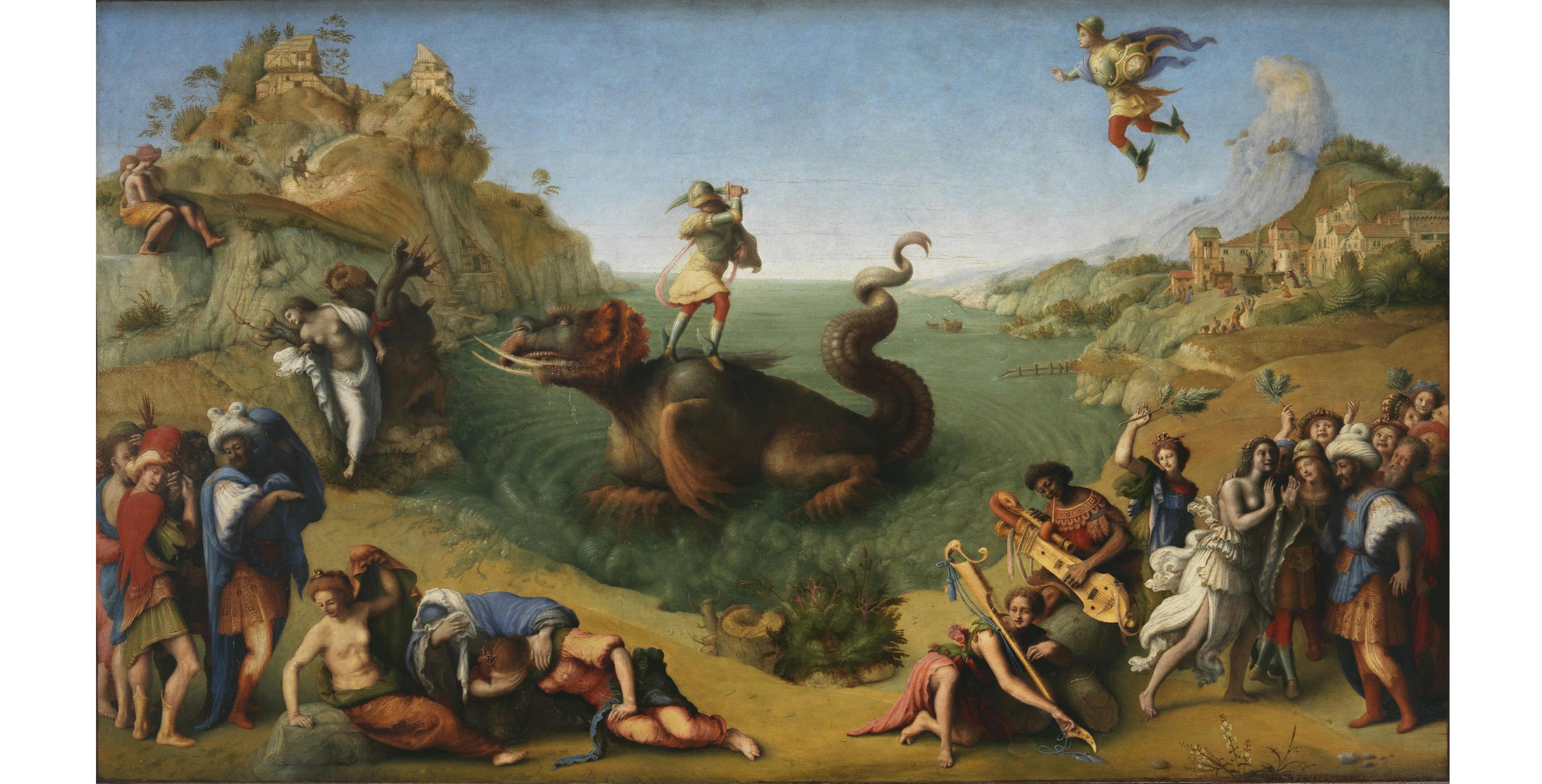
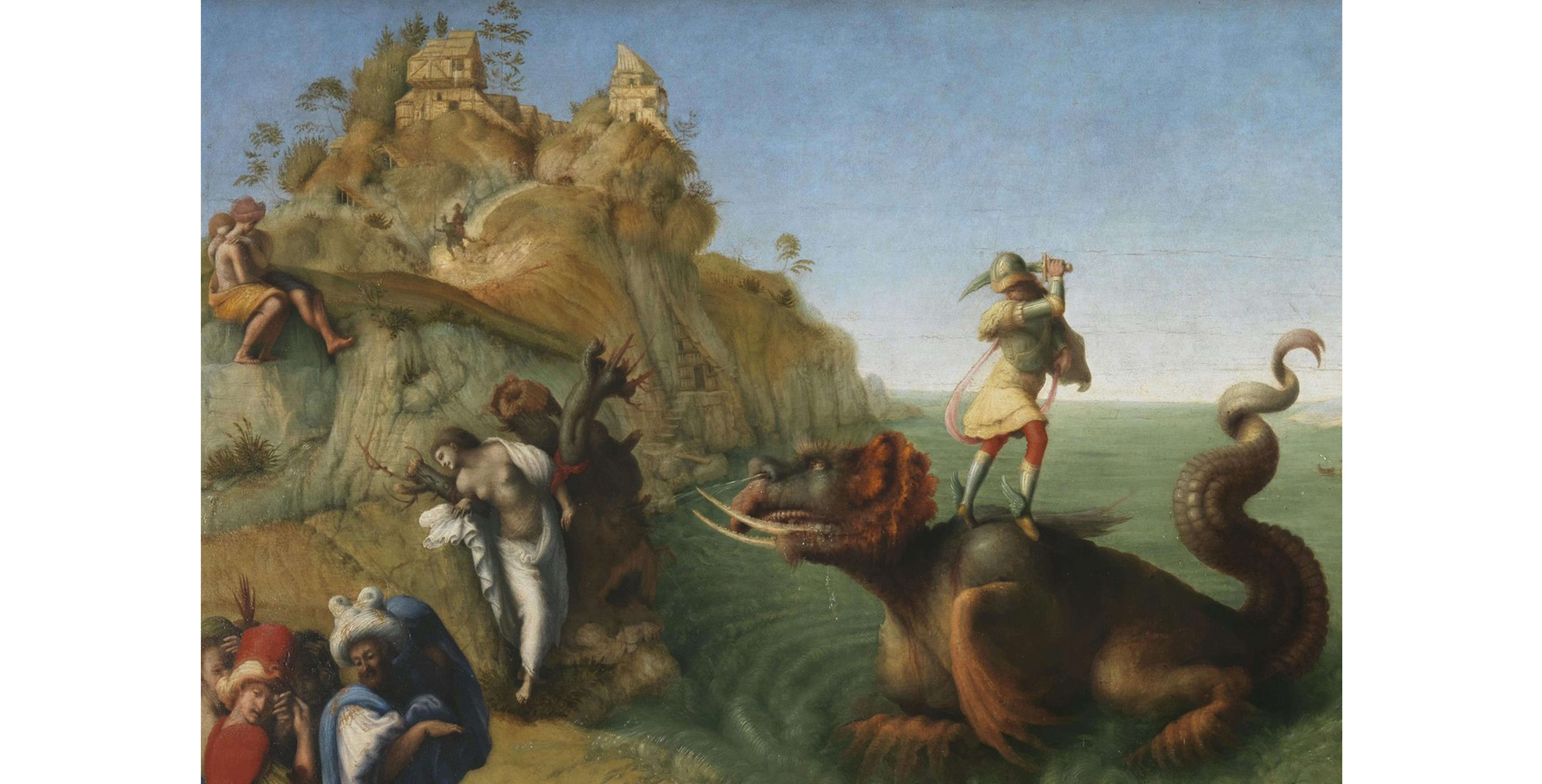
It is dawn. Under a clear sky, a warm embrace, perhaps the last one between Andromeda and Cassiopeia, the mother who had boasted she was the most beautiful of the Nereids. In his Metamorphoses, Ovid narrates how, in order to punish her, Poseidon sent a terrible monster to raid the coast of the kingdom of Andromeda’s father, Cepheus.
The first time I saw this painting, I was struck by the monster, a dragon that looks gentle rather than scary, like those creatures that can be found inside a book of fairy tales. It could only have been painted by Piero di Cosimo, an artist of “witty and extravagant invention”.
Then, as my gaze moved over the canvas, I saw a girl tied to a tree. In the foreground, three despairing women, their faces buried in their hands, bodies hidden inside their cloaks, totally absorbed in their weeping. They are unable to look at what is happening. And I can’t look at them without a feeling of rage taking hold of me. A tragedy is taking place and no one is intervening. It is easier not to look, not to be there! Like for men, whose pose shows just a hint of distress.
I got lost in this story. I looked and searched. Only then did I notice the two figures, embracing on the hill, to the left. Perhaps two lovers or, looking closer, a mother and daughter. One abandoning herself to the other, who embraces her.
Andromeda knows that she has to die: the oracle has asked for her sacrifice to placate the ire of Poseidon and of the other nymphs. But she is unable to leave that embrace, the sweet smell of her mother, which is so reassuring…
… This embrace led me to start weaving this story into my own.
And I suddenly thought of you, my new friend in a new town. You, who for me were like a safe presence, a warm embrace. I arrived in Florence, looking forward to opening myself up to new experiences. You arrived shortly after, in that flat on the top floor in Santo Spirito. We shared so much during that time, and even when we went our separate ways, we stayed close, even at a distance: through marriages, children, and sorrows. I knew you were there, and we understood each other, and we had much to give each other.
Yours was a warm embrace.
Andromeda had to leave the embrace of her mother. Now she is naked, tied to a tree trunk, feeling the strong ropes that tighten over her arms. Her nerves are tense with fear; her face is grey.
When I look at Andromeda, unable to react, I think of the pain that does not allow you to do anything, to think, to be present, because it is paralyzing. And when I see Andromeda with her exposed breasts, that she cannot cover or defend, I think about my pain that cannot be hidden or avoided because it is inside me.
When my father died, I felt alone. I had also lost my mother and it wasn’t fair. Suddenly, I was no longer a daughter. I felt like I had lost my roots, my past. All gone. The monster arrived suddenly, even if heralded…
Suddenly, the monster’s breath is on her.
“Where are you? Father, mother?”
Andromeda can see a group in the distance, backs turned to her. There is her father, Cepheus. At his feet, Cassiopeia, her mother, is weeping. But Andromeda is dying!
Not a look. Not a word.
I don’t know why you turned away, my friend, and why you no longer looked at me. Perhaps you couldn’t bear my pain. I stopped seeking you out.
Perseus, the young savior, flies proudly in. He can see Andromeda.
He lands elegantly on the monster’s back; his feet touch its soft flesh. A dull thud and immediately, he attacks it from behind. The monster gasps, sprays water from its nostrils… Yes!
You arrived softly, my son, and soothed everything. You look at me with your big eyes and my fears disappear; my heart is warmed, it hopes, it rejoices. Without even knowing my terror, you defeat it.
A festive atmosphere: there’s music, branches are waved, and eyes look up to the heavens in gratitude. Andromeda dances towards her hero, who looks at her with a dreamy expression. It is truly over!
Piero di Cosimo has just finished telling the story of the freeing of Andromeda. The episodes follow one another in rapid succession, they overlap. It is a narrative method that is typical of Piero, amplified by his extraordinary ability to observe and reinvent nature. He was taught this by Leonardo da Vinci, with whom Piero studied.
It was his fervent imagination that won him the commission for the large, bizarre allegorical wagons for the Medici court. In “Perseus Freeing Andromeda”, Piero uses all the experience acquired in the creation of those dramatic devices. Perseus’ feat is nothing more than a metaphor for the liberation of Florence from the monster of the Republic: the felled trunk on the shore is a clear allusion to a Medici emblem, with the laurel bough that flourishes once more.
On the hill, where Perseus offers sacrifices to the gods, the fairy-tale village lights up with gratitude, and everyone flocks there to rejoice. The relief is contagious, like happiness.
Life with my son is always a surprise and a celebration. I look at the sky and give thanks. I am still a little dazed, but when fear comes back, and disappointment is around the corner, he is there to give me hope, a smile. He needs my attention and he forces me to be there, for him. And I am there, for my savior. And I forget... And always give thanks.
Text by Viviana Fanizza
Voice by Ottavia Piccolo
Artwork detailsPerseus frees AndromedaPainting | The Uffizi - 22/24Piero di Cosimo, Perseus frees Andromeda
Andromeda had to leave the embrace of her mother. Now she is naked, tied to a tree trunk, feeling the strong ropes that tighten over her arms. Her nerves are tense with fear; her face is grey.
When I look at Andromeda, unable to react, I think of the pain that does not allow you to do anything, to think, to be present, because it is paralyzing. And when I see Andromeda with her exposed breasts, that she cannot cover or defend, I think about my pain that cannot be hidden or avoided because it is inside me.
When my father died, I felt alone. I had also lost my mother and it wasn’t fair. Suddenly, I was no longer a daughter. I felt like I had lost my roots, my past. All gone. The monster arrived suddenly, even if heralded…
Suddenly, the monster’s breath is on her.
“Where are you? Father, mother?”
Andromeda can see a group in the distance, backs turned to her. There is her father, Cepheus. At his feet, Cassiopeia, her mother, is weeping. But Andromeda is dying!
Not a look. Not a word.
I don’t know why you turned away, my friend, and why you no longer looked at me. Perhaps you couldn’t bear my pain. I stopped seeking you out.
Perseus, the young savior, flies proudly in. He can see Andromeda.
He lands elegantly on the monster’s back; his feet touch its soft flesh. A dull thud and immediately, he attacks it from behind. The monster gasps, sprays water from its nostrils… Yes!
You arrived softly, my son, and soothed everything. You look at me with your big eyes and my fears disappear; my heart is warmed, it hopes, it rejoices. Without even knowing my terror, you defeat it.
A festive atmosphere: there’s music, branches are waved, and eyes look up to the heavens in gratitude. Andromeda dances towards her hero, who looks at her with a dreamy expression. It is truly over!
Piero di Cosimo has just finished telling the story of the freeing of Andromeda. The episodes follow one another in rapid succession, they overlap. It is a narrative method that is typical of Piero, amplified by his extraordinary ability to observe and reinvent nature. He was taught this by Leonardo da Vinci, with whom Piero studied.
It was his fervent imagination that won him the commission for the large, bizarre allegorical wagons for the Medici court. In “Perseus Freeing Andromeda”, Piero uses all the experience acquired in the creation of those dramatic devices. Perseus’ feat is nothing more than a metaphor for the liberation of Florence from the monster of the Republic: the felled trunk on the shore is a clear allusion to a Medici emblem, with the laurel bough that flourishes once more.
On the hill, where Perseus offers sacrifices to the gods, the fairy-tale village lights up with gratitude, and everyone flocks there to rejoice. The relief is contagious, like happiness.
Life with my son is always a surprise and a celebration. I look at the sky and give thanks. I am still a little dazed, but when fear comes back, and disappointment is around the corner, he is there to give me hope, a smile. He needs my attention and he forces me to be there, for him. And I am there, for my savior. And I forget... And always give thanks.
Text by Viviana Fanizza
Voice by Ottavia Piccolo
Artwork detailsPerseus frees AndromedaPainting | The Uffizi - 23/24Luca Signorelli, Holy Family
It all revolves around the Child.
Joseph looks as though he has just arrived. Joseph, with a colorful scarf around his neck, arms crossed as a mark of respect, and such a wise expression on his face, showing awareness of his own limits. With his leg, he encloses the space around the Child, as if to protect him.
His figure is bent to adapt to the shape of the round painting. He occupies the space left to him, aware of the role he has been given.
He approaches Mary and Jesus as if on tiptoe, with an attitude almost of modesty and reverence before the mystery of motherhood. He is looking in on an intimate space.
Mary is beautiful and at ease in this space. Her legs are outstretched, relaxed. A soft red cloak wraps around her, down to her feet.
Her skin is bright and her expression focused, absorbed in reading a book.
To our eyes, she is not melancholy, as many have interpreted her expression, because she is thinking of the fate of Jesus... To our eyes, Mary is a serene mother who is reading and teaching her child. The book on the ground and the one in her hands represent the passage from the old religion, founded on law, to the new one, based on love.
She is not afraid of what’s to come... She is living in the moment.
Jesus is standing, leaning against his mother. He is surrounded by the tenderness and teachings of Mary, as well as the adoration and protection of Joseph. He has just turned around; with his hand, he stops his mother's reading, his gaze moves beyond the figure of his father.
Joseph’s face is sad, hollowed and grey. The contrast between his dull complexion and the brightly colored scarf seems to reveal an inner state.
It is as if he were bowing before the force of the divine plan. He has great difficulty in accepting not so much the mystery of the child that is not his, as the consequences of this mystery. He silently promises Mary and Jesus that he will do all he can to protect them. It is as if he were saying: “I will watch you; I will watch over you, but I won’t disturb you...”
Here we are: me, you and our son, Riccardo. We three inside a circle that is like a protective boundary, enclosing our ability to find strength together, to control and manage our pain.
When he was born, the happy event turned into a tragedy in just a few seconds.
Our son was able to survive the trauma caused by that woman’s negligence, and perhaps neither you nor I were aware of just how painful the consequence of that trauma, that damned turmoil, caused by just a few seconds without oxygen would be… and here he is, our son, at the heart of the turmoil that upturned our lives.
It wasn’t easy to accept the damage done to Riccardo and even now, so many years later, I still can’t...
The circle of pain closed itself around our lives: every time we tried to get out, even during moments of absolute happiness, such as the birth of two more children, we had to go back inside again. Travel, great school results, friends: all achieved in the shadow of pain.
Our pain is powerful, though, it is our strength.
It is the same strength that has enabled Riccardo to make such good progress, to achieve the unthinkable. He feels pain but, unlike us, he can see beyond the circle, almost stubbornly.
I want my child not to depend on me. We have created a space for him, a social life. It's our life that is closed. It revolves around him, without any room in which to breathe.
When we get home, it’s as though nothing else exists. We live in a small space; the flat is small, movement is limited, travel increasingly difficult.
I don’t think it is a coincidence that this Holy Family made me stop and think.
It was painted at the end of the 15th century by Luca Signorelli, the Renaissance artist described by various art historians as the forerunner of Michelangelo.
The figures have an almost sculpted quality, and the space around them is so compressed, so claustrophobic, that Mary and Joseph seem almost projected outside the surface of the painting. This is what my trained artist’s eye tells me. However, there is more. The idea of a circle that closes and isolates strikes a deep chord in me, as does St. Joseph’s attitude: attentive and protective, yet apart. It is not so much a question of physical distance, since all distance is cancelled out in this space. What struck me is the “difference” in Joseph compared with Mary and Jesus. It is a difference that Signorelli has portrayed in different ways: Joseph is the most constricted figure in the round form, almost as if forced inside with difficulty; his grey complexion contrasts greatly with that of his wife and child; even the fact that he has a different halo can be interpreted as a way of distinguishing him from Mary, the only one to be born without original sin, and from the Child, the Son of God.
Yet, with his entrance, Joseph is the figure that gives balance to the composition, and a kind of completion to the family.
At times, when we are sitting on the sofa, Riccardo will suddenly look up at the ceiling and smile. Perhaps he sees his angel.
He is able to see beyond.
Text by Magdy Hassan and Eliana Caputo
Voices by Marco Martinelli and Ermanna Montanari
Artwork detailsHoly FamilyPainting | The Uffizi - 24/24Luca Signorelli, Holy Family
Here we are: me, you and our son, Riccardo. We three inside a circle that is like a protective boundary, enclosing our ability to find strength together, to control and manage our pain.
When he was born, the happy event turned into a tragedy in just a few seconds.
Our son was able to survive the trauma caused by that woman’s negligence, and perhaps neither you nor I were aware of just how painful the consequence of that trauma, that damned turmoil, caused by just a few seconds without oxygen would be… and here he is, our son, at the heart of the turmoil that upturned our lives.
It wasn’t easy to accept the damage done to Riccardo and even now, so many years later, I still can’t...
The circle of pain closed itself around our lives: every time we tried to get out, even during moments of absolute happiness, such as the birth of two more children, we had to go back inside again. Travel, great school results, friends: all achieved in the shadow of pain.
Our pain is powerful, though, it is our strength.
It is the same strength that has enabled Riccardo to make such good progress, to achieve the unthinkable. He feels pain but, unlike us, he can see beyond the circle, almost stubbornly.
I want my child not to depend on me. We have created a space for him, a social life. It's our life that is closed. It revolves around him, without any room in which to breathe.
When we get home, it’s as though nothing else exists. We live in a small space; the flat is small, movement is limited, travel increasingly difficult.
I don’t think it is a coincidence that this Holy Family made me stop and think.
It was painted at the end of the 15th century by Luca Signorelli, the Renaissance artist described by various art historians as the forerunner of Michelangelo.
The figures have an almost sculpted quality, and the space around them is so compressed, so claustrophobic, that Mary and Joseph seem almost projected outside the surface of the painting. This is what my trained artist’s eye tells me. However, there is more. The idea of a circle that closes and isolates strikes a deep chord in me, as does St. Joseph’s attitude: attentive and protective, yet apart. It is not so much a question of physical distance, since all distance is cancelled out in this space. What struck me is the “difference” in Joseph compared with Mary and Jesus. It is a difference that Signorelli has portrayed in different ways: Joseph is the most constricted figure in the round form, almost as if forced inside with difficulty; his grey complexion contrasts greatly with that of his wife and child; even the fact that he has a different halo can be interpreted as a way of distinguishing him from Mary, the only one to be born without original sin, and from the Child, the Son of God.
Yet, with his entrance, Joseph is the figure that gives balance to the composition, and a kind of completion to the family.
At times, when we are sitting on the sofa, Riccardo will suddenly look up at the ceiling and smile. Perhaps he sees his angel.
He is able to see beyond.
Text by Magdy Hassan and Eliana Caputo
Voices by Marco Martinelli and Ermanna Montanari
Artwork detailsHoly FamilyPainting | The Uffizi



Factories of Stories
uffizipass.com/en/special-visits/factoriesofstories
Twelve Uffizi’s masterpieces narrated in audio-tracks offer the public an unusual vision of the works, along with the museum as an inexhaustible “workshop” of stories.
The storytellers of Factories of Stories are museum operators and foreigners living in Italy who have intertwined their experience with the history of the works, giving them new meanings and connotations. Their intense and evocative stories reveal knowledge and emotions, as well as individual and collective experiences about universal themes like family, friendship, prayer and travel.
You can listen the stories in Italian and in their original language (Arabic, Farsi, Mandarin, French and Spanish) from home or during the museum visit with any mobile device (smartphone or tablet) and earphones.
A project of the Cultural Mediation and Accessibility Unit. Editing and publishing by the Department of Digital Strategies. Publication: May 2019
Curated by Simona Bodo and Maria Grazia Panigada
Texts: Mohammad Aletaha, Silvia Barlacchi, Fabiana Bianchini, Lina Callupe, Eliana Caputo, Viviana Fanizza, Magdy Hassan, Zeinab Kabil, Diana Kong, Samira Lahhane, Kuassi Sessou, Sofia Sessou, Maria Spanò.
Voices: Giacomo Armaroli, Marco Baliani, Micaela Casalboni, Lella Costa, Laura Curino, Lucilla Giagnoni, Giulia Lazzarini, Marco Martinelli, Ermanna Montanari, Maria Paiato, Marco Paolini, Ottavia Piccolo, Paola Roscioli, Arianna Scommegna.
Photos by Francesco del Vecchio e Roberto Palermo (Dipartimento Fotografico)